Journal14 min read
How to Choose a Product Video Production Agency for Your Product Team
Shortlist a product video production agency with five checks, real price ranges and a 100-point scoring sheet built for SaaS product teams.
- Published
- Updated
- Written by
- AllCapStudio

Picking a product video production agency goes wrong in two predictable ways. Portfolios often lead with brand films, which say little about how an agency handles software screens. Quotes often arrive as one total with no stages, review rounds or file ownership, so you cannot compare two of them. Then your product ships a redesign, and a demo that cost thousands shows screens your users will not find in the product.
At AllCapStudio, we make explainers, product demos and onboarding walkthroughs for product teams, and the questions in this guide are the ones clients ask us on calls. Each check comes with what a good answer sounds like and what we do ourselves, so you can hold us to the same standard.
Here is the method in four steps. First, rule out agencies that cannot show finished screen-based projects in your category or name the people who would make your video. Second, request an itemized quote that lists review rounds, usage rights and the cost of updates. Third, score each remaining agency on six weighted criteria for a total out of 100. Fourth, pick the top total and read its lowest-scoring row before you sign. The sections below explain each step.
What Does a Product Video Production Agency Do?
A product video production agency plans, scripts, produces and delivers videos about a software product, such as explainers, demos and onboarding films. Production covers planning, scripting, filming or animating, sound and delivery. Distribution covers publishing and promoting the finished video, which video marketing agencies handle, and some production agencies add it.
In this guide, a product team means the people who build, launch and market a software product, usually at a SaaS company (a business that sells software by subscription). Agencies describe themselves as a SaaS video production agency, a B2B video production agency or a product launch video agency, and the labels overlap.
Types of Product Videos for SaaS Companies
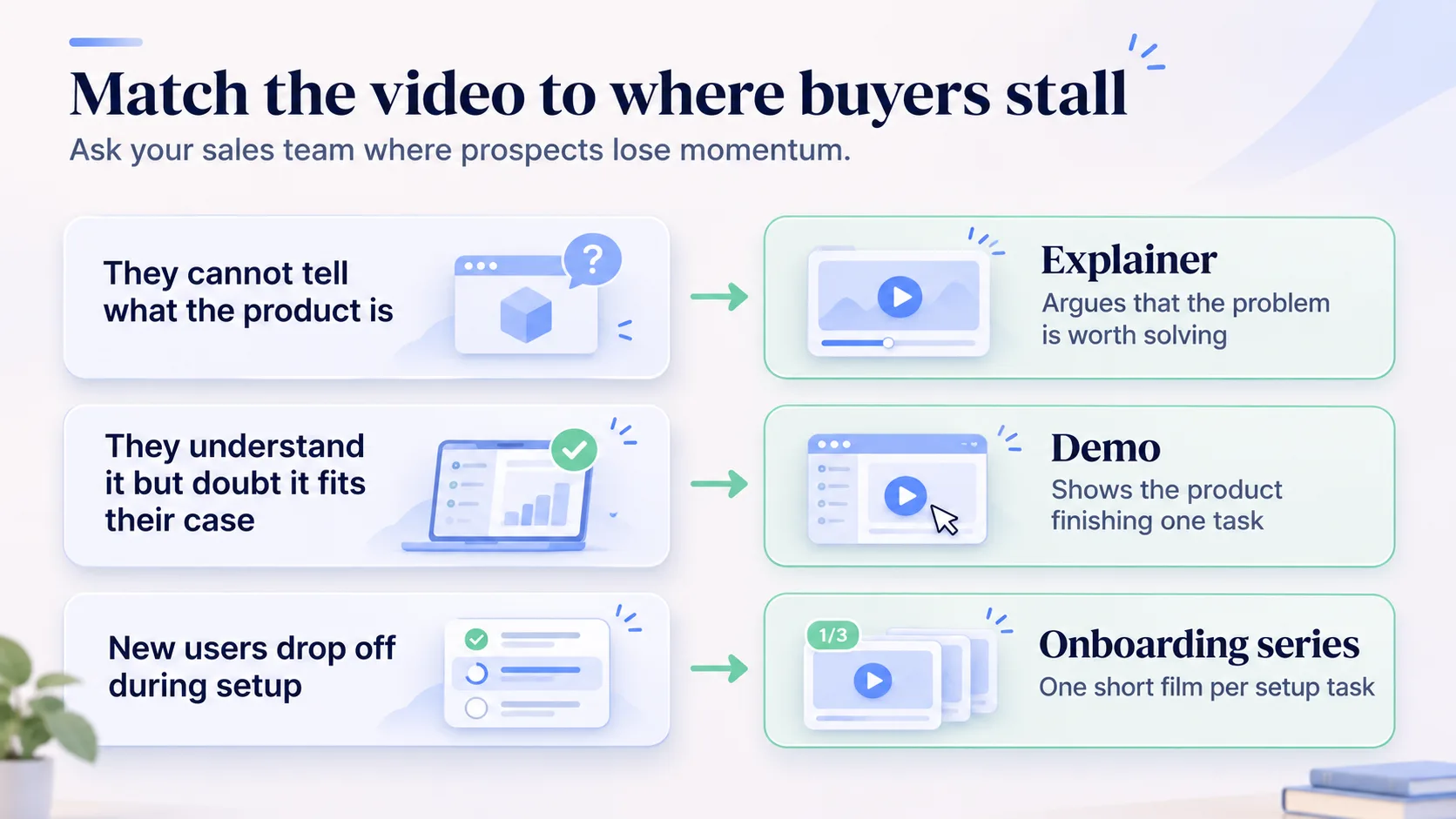
Choose an explainer when buyers do not yet understand the problem or the product. Choose a demo when they understand it but doubt it will work for them. Launch films announce a release, and onboarding series teach new users one task at a time. Agencies sell SaaS explainer video production and product demo video production as separate services because the two call for different skills.
Format | What it is | Question it answers | How fast it dates |
|---|---|---|---|
Explainer | An animated argument that a problem is worth solving | Why should I care? | Slowly, because it shows few interface screens |
Demo | A recording of the product's real screens (the interface) completing a task | Will this work for me? | Quickly, because it shows current screens |
Launch film | An announcement of a release | What changed and why does it matter? | Depends on how much interface appears |
Onboarding series | One short film for each task a new user must learn | How do I finish this task? | Quickly, though one film per task limits the damage |
Here is the test we use. Ask your sales team how long a prospect takes to understand what the product is on a first call. More than about two minutes points to an explainer. Immediate understanding followed by stalling on whether it fits their case points to a demo.
Types of Product Demo Videos and Their Uses
Demos split into styles by where they are watched. We build sales, website and onboarding demos, among others, and each has its own length and job.
Style | Length or shape | Job |
|---|---|---|
Sales demo | 2 to 3 minutes | Sent before or after a call to warm the wider buying committee |
Website demo | 60 to 90 seconds | Plays on a page, silent-first with captions |
Onboarding walkthrough | A short series of single-task films | Sits inside the product and guides new users |
Write the demo for the buying committee. Your champion already understands the product, and the demo has to survive being forwarded to a finance lead or a security reviewer who will watch ninety seconds at most. That audience favors a demo that follows one person finishing one task over a tour of the menus.
How a Video Project Runs, and How Long It Takes
Most projects pass through five stages, though studios label them differently.
Stage | What happens | What you approve |
|---|---|---|
Brief | A call and a written summary of the goal, audience and deadline | The goal and who decides |
Script | The words of the video, usually in two drafts | The final script |
Storyboard | A sequence of designed frames, with timing, showing every scene before any animation or recording begins | The look and the order of scenes |
Build | Animation or recording, sound and editing, with a rough cut (an early assembly with placeholder audio and unfinished frames) shown at the halfway point | Notes on structure and pacing |
Delivery | The final file plus shorter edits, phone-format versions (9:16), captions and editable project files | Everything on the delivery list |
Some studios add a casting step, where the team is assigned to the brief. Each time you send feedback and the studio revises, that counts as a review round.
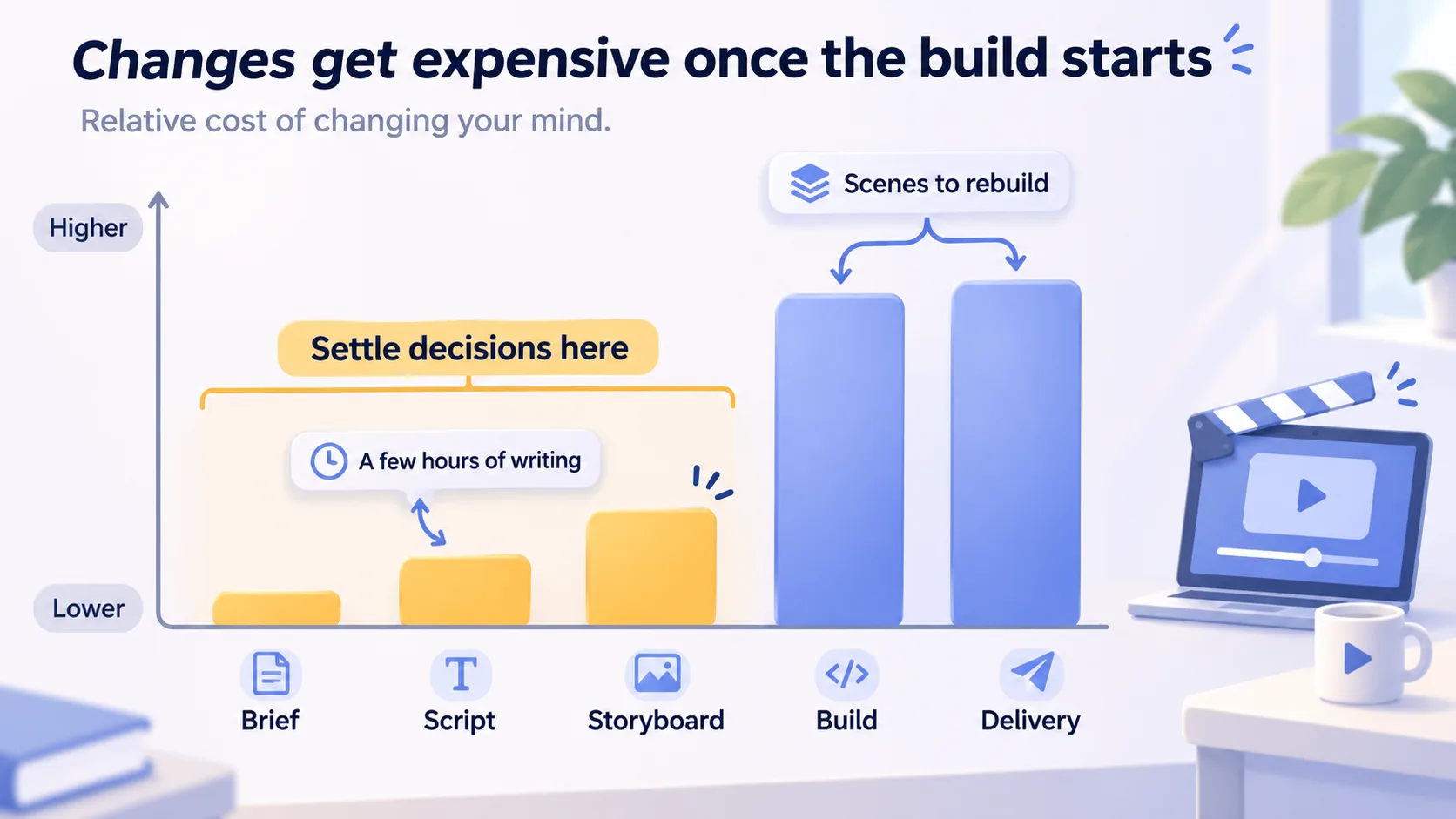
Money and effort are spread unevenly across those stages. Most of the budget goes into the build, once animation begins and the first rough cut appears, while the early weeks cover discovery, script and style frames. A script change in week two costs a few hours of writing. The same change in week four means rebuilding scenes, so the first two weeks are where decisions should be settled.
Timelines vary by format and by studio. Venture Videos, a SaaS-focused agency, gives four weeks as its target for launch films and six weeks as typical for enterprise explainers. No stage starts before the one before it closes, so each late approval pushes delivery back by the same amount and two late approvals add up.
Plan backward from the date the video must be live, and treat script approval as the main schedule risk.
Fix the live date, with no padding.
Count back the weeks the studio quotes for your format.
Add a buffer week if more than two people approve the script.
Name one person who can approve a script without a committee, and do it before the first call.
Agency vs Studio vs Freelancer vs In-House Video Production
The right model depends on how many videos you need each year and how often your interface changes.
Two terms need a definition first. A studio with a cast bench keeps a vetted pool of directors, animators and editors and assigns a team from it to each project, instead of keeping a fixed team on payroll. That is the model we run. In-house means your own employees produce the video.
Option | Fits when | How you pay | Watch for |
|---|---|---|---|
Agency | Several formats a year, a fixed date, no in-house video skills | Retainer or per project | Overhead priced into every quote |
Studio with a cast bench | Formats change from project to project | Per project | Depth of the bench, so check finished work |
Freelancer | One scoped piece with a finished script | Hourly, daily or per project | You manage strategy, schedule and revisions |
In-house | Video every week | Salary | Salary carried through slow months and skill gaps |
Freelancers generally charge lower rates and run a leaner structure, a trade-off covered in Clutch's freelancer versus agency guide. Our comparison of agency, in-house, freelance and cast bench production carries the cost tables for each model.
Low volume with a fixed date points toward an agency or studio, and daily volume points toward in-house. Many teams combine two models, for example an in-house editor for weekly clips and a studio for flagship films.
Two situations call for skipping an agency altogether. If your screens change every sprint, a five-week project goes stale quickly, so look at tools that regenerate a demo after each release or at videos built in separate parts. And if your budget is tight, you are not alone. 51% of respondents across marketing, sales, product, operations and leadership roles report flat or reduced video budgets in Wistia's 2026 State of Video report. One well-chosen demo may do more than a series.
What to Check Before You Shortlist a SaaS Video Production Agency
Check five things before you shortlist an agency. Each comes with a question for the first call, a sign of a good answer and how we handle it ourselves.
Relevant Product Video Portfolio
A film for a payments API and a film for a hardware device need different skills, so a strong reel in one style says little about the other.
Ask: Which projects in your portfolio show a real product interface, and in which category?
A good answer: Named screen-based projects in a category near yours, where each demo follows one person finishing one task.
How we handle it: We lead with screen-based projects, and two of them are described near the end of this guide.
Production Team and Creative Expertise
A showreel can compile work from dozens of people you will never meet.
Ask: Who will work on my video, and when have you advised a client against making one?
A good answer: A named director, animator and editor with individual reels, plus a specific example of saying no.
How we handle it: Every client sees who is cast on their project and the work each person has done. If that reel does not convince you, we cast again. If a video is the wrong fix, we say so at the brief call.
Video Production Process and Review Rounds
A recorded approval at each stage stops a decision made in week one from reopening in week four.
Ask: What does each stage end with, and how many review rounds does the quote include?
A good answer: A list of stages, an approval at each, a set number of rounds per stage and a price for extra rounds.
How we handle it: Every stage ends in a written approval, and revisions run in fixed rounds per stage.
Demo Data and Post-Production Updates
Demo data is the sample customers, records and numbers visible on screen. A table of three customers named Test undoes the rest of the film.
Updates matter just as much. TechSmith notes that training videos built in modular chunks are far easier to fix than one long recording, and the same applies to demos. A video built in separate layers, such as screen recording, callouts and voice, lets one layer be replaced after a redesign.
Ask: How do you build demo data, and what happens when our interface changes after delivery?
A good answer: A realistic dataset built before recording, and a video assembled in layers so one screen can be swapped.
How we handle it: We build a plausible dataset before recording a single frame, and we assemble demos in layers so a redesigned screen means replacing one capture and not remaking the film.
Ownership and Delivery
Editable project files are what let someone update the video later. Usage rights cover the music, voice and on-screen people in the video, and they are usually limited by region and time.
Ask: What do we receive at delivery, and who owns the finished video and its usage rights?
A good answer: Everything on the delivery list from the stage table, with ownership transferring at delivery and music and voice terms stated.
How we handle it: Ownership transfers on delivery, and the handover includes the full delivery list and the editable project files.
Price comes next, because the structure of a quote reveals more than its total.
Product Video Production Costs and Pricing
A SaaS product demo typically costs between $1,500 and $15,000, according to Vidico's product video cost guide. The low end is a screen recording with a voiceover, and the high end is a fully animated walkthrough. Most business-to-business SaaS companies land between $2,500 and $5,000 for a 2 to 3 minute demo.
Vidico also estimates that hidden costs add 15 to 30% to a first quote. The usual sources are additional review rounds (at $500 to $2,000 each), re-recording screens after a product change and reformatting for each platform.
We publish starting prices of $2,800 for product demos and $3,400 for explainers, and a 90-second 2D explainer typically lands between $6,000 and $9,000. The gap between a starting price and a typical price comes mostly from production style and shoot days (days of filming with a crew). Character animation and 3D cost two to four times what motion graphics cost per finished minute. The remaining drivers are number of deliverables, talent and usage rights, and timeline, with a 25% surcharge for a rush.
A usable quote shows its working, and the table below sets a weak quote beside a usable one.
Line item | Weak quote | Usable quote |
|---|---|---|
Scope | One total for "a demo video" | Cost by stage, brief through delivery |
Review rounds | "Revisions as needed" | A fixed count per stage, with extras priced separately |
Usage rights | Not mentioned | Music, voice and talent terms, with region and duration |
Rush | Added after you agree | Surcharge stated before you commit |
Updates after release | Not mentioned | A stated price or process for replacing screens after a redesign |
Every quote we send breaks down against the same line items. A one-line total gives you nothing to compare against the next agency's number.
How to Compare and Score Product Video Agencies
Once two or three agencies have answered your questions, a weighted sheet turns the answers into a ranking.
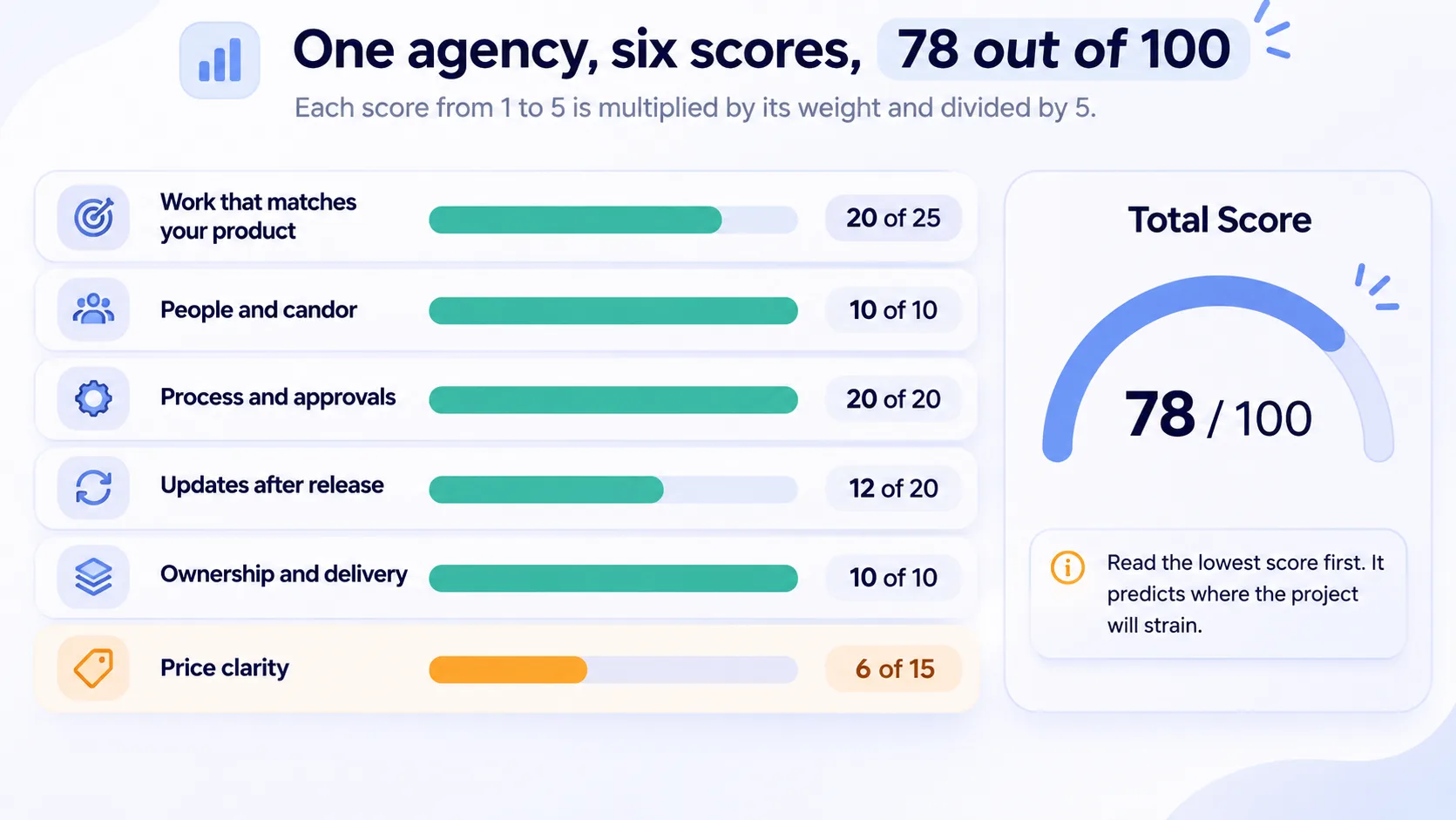
Score each agency from 1 to 5 on every criterion. Multiply each score by its weight, divide by 5 and add the results for a total out of 100. The weights are a suggested starting point, so adjust them to your situation.
Criterion | Weight | A 5 looks like | A 1 looks like |
|---|---|---|---|
Work that matches your product | 25 | Screen-based projects in a near category | Brand films only |
People and candor | 10 | Named team, individual work, an example of advising against a video | Studio name only |
Process and approvals | 20 | Written approval and set review rounds at every stage | Informal feedback, open-ended revisions |
Updates after release | 20 | Built in layers, with realistic demo data | One flattened export |
Ownership and delivery | 10 | Files and usage rights transferred at delivery | Ownership unclear |
Price clarity | 15 | Itemized quote, published starting prices | One-line total |
An illustrative agency scores 4 on work fit (20 points), 5 on people (10), 5 on process (20), 3 on updates (12), 5 on ownership (10) and 2 on price clarity (6). The total is 78. Compare totals across finalists, then read each finalist's lowest-scoring row, because that row predicts where the project will strain.
When to Choose AllCapStudio
We cast every project from a vetted bench of more than 40 partner creatives and run it with one producer, one schedule and one invoice. Projects take two to five weeks, and our portfolio includes a 78-second explainer for a payments API nobody could describe and six onboarding walkthroughs for a developer tools company, recorded in a single session.
Casting matters for a product team. An explainer needs someone who can argue a point visually, and a demo needs someone who can choreograph a task on screen. A 2D character piece and a 3D hardware build also call for different animators.
We fit best when a video carries pipeline weight, when the argument is hard to get right or when the format needs specialist craft. Those are the projects where six stages and written approvals earn their weeks.
Conclusion
A video starts aging the day it ships, so choosing an agency is also a decision about who maintains the result. Before you sign, ask what the next three product releases will do to the film and who will update it. Then keep a one-page register of every video, the screens it shows and the person who owns it, and review the register at each major release. Videos that show the interface go first, and explainers can wait.
Plan the second video before the first one ships, and sequence it by where your buyers stall. Prospects who struggle to understand the product need an explainer, prospects who understand it but hesitate over fit need a demo, and new users who drop off during setup need an onboarding series. The evidence for each is already in your sales calls and support tickets, and sales calls are the first thing we ask for at the brief.
If you want a first quote built on the line items above, send us the brief and we will reply with a written scope, a price and a schedule.
Written by the AllCapStudio team. We publish what we would tell you on a call, which occasionally costs us the project.
Read next
All articles- Journal6 Best HeyGen Alternatives in 2026, Compared by Price, Limits and FitCompare 6 HeyGen alternatives for 2026 by price, free plans, limits and fit, including Synthesia, CoAnimator, Colossyan, D-ID…
- Journal7 Best Auto Caption Generators for Video in 2026Compare the 7 best auto caption generators for video in 2026, with annual pricing, accuracy limits, burn-in vs SRT, and the best…
- JournalAgentic Video Production vs Traditional Video Production: What Changes in 2026?What agentic video production changes about cost, speed, and creative control in 2026, and where a human-directed bench still wins.