Journal18 min read
Agentic Video Production vs Traditional Video Production: What Changes in 2026?
What agentic video production changes about cost, speed, and creative control in 2026, and where a human-directed bench still wins.
- Published
- Updated
- Written by
- AllCapStudio

A SaaS team needs a ninety-second product demo before a launch in nine days. A DTC brand needs a founder-led brand film to carry a paid campaign for a year. A marketing team needs six vertical cuts of the same ad, every week for a quarter. These three teams should not build their video the same way, and in 2026 they are no longer choosing only between one AI tool and one agency.
A third model has opened up between the two. In agentic production, an AI coding agent plans and builds a video from a written description. At the other end, a human team scripts, casts, and shoots. Picking the wrong one costs money either way: a rushed generator clip on a brand film that has to run for a year, or a five-week production schedule for a demo that needed to ship on Friday.
This guide explains how each model works, where they differ on seven dimensions (timeline, cost, direction, output quality, scale, rights, and maintenance), what stays the same whichever you choose, and how to decide.
The short answer: Agentic production suits videos that change often and can be rebuilt from project files, such as demos, tutorials, and product updates. A production team suits videos that have to be right once and carry a brand, such as a brand film or a flagship launch video. Most teams end up using both.
What Agentic Video Production Means
Agentic video production means an AI agent decides the steps needed to build a video, instead of a human editor pressing one button at a time. You describe a product demo or a launch video, and a connected agent researches the product, drafts the script, builds the scenes, and renders the file. If a scene misses the brief, the agent corrects it before you see it.
The important part is the loop. The agent plans, builds, checks its own work against the description, and revises. You stay in the process as the person who reviews the script, watches the draft, and gives notes, but you are directing the work rather than operating the software.
Agentic Video vs. Single-Shot AI Generation
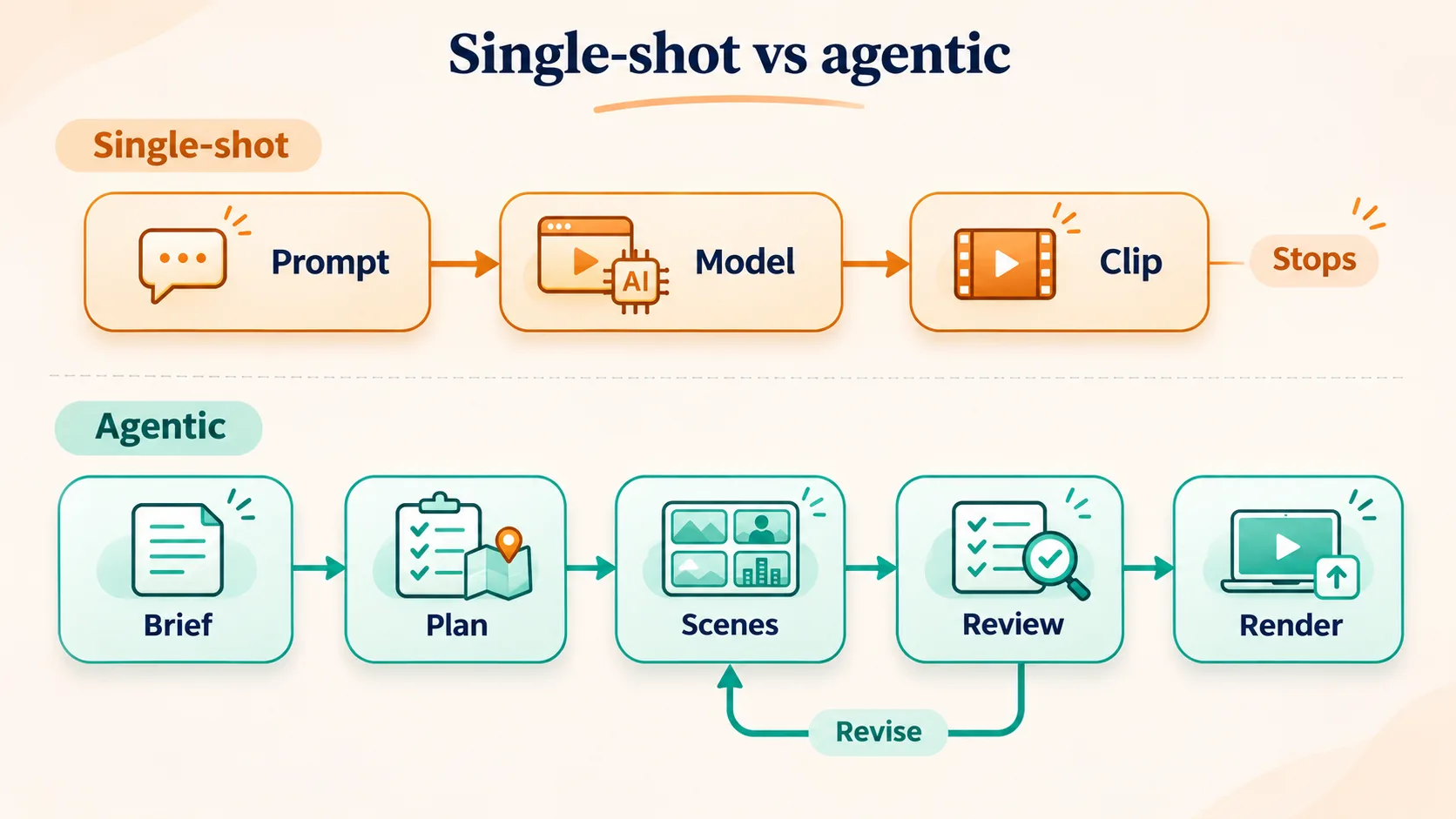
Most of what gets called AI video today is still single-shot generation. A model like Google Veo takes a prompt and returns one clip. It has no memory of the script around that clip, and no way to check whether the clip fits the beat a launch video needed at that moment. You get a result, and everything else (sequencing, pacing, captions, audio, assembly) is still your job.
An agentic tool wraps that kind of generation in planning. It decides what the video needs, calls the right generator or builds the scene itself, and assembles the result. Single-shot models can still be part of the process, but they become one tool the agent uses rather than the whole workflow.
The field is still young. A 2026 benchmark called AgenticVBench tested whether AI agents can complete real post-production tasks end to end, rather than one generation step at a time. It treated the question as open research, not a solved problem, which is a fair summary of where the technology stands.
How Agentic Video Production Started
Andreessen Horowitz partner Justine Moore argued in January 2026 that video production has long followed a rough rule: editing takes most of a project's time, and generating or filming takes the rest. That imbalance explains why agentic tools started with editing and post-production before moving into building whole videos from a description. The slowest part of the job was the first to be automated.
3 Examples of Agentic Video Production Tools
A few tools already work this way, and each connects a different kind of agent to the build.
Tool | What it does | How you work with it |
|---|---|---|
Connects to Claude Code, Codex, Antigravity, or OpenClaw. The agent builds and renders the video locally. | You describe a scene, and the agent writes it as project files you can edit later. | |
The planning layer built on Gemini inside Flow, not Veo itself. It plans, generates, and organizes clips. | You work from one chat inside Flow. | |
Turns a written brief into finished assets, choosing which model handles each shot and planning the workflow. | You write the brief, and the system decides which generator to use for each shot. |
All three start from a written description instead of a timeline, which is what makes them agentic rather than single-shot. Agentic video editing is a related category in which an agent works on footage you already shot instead of building a new scene. It follows different rules and deserves its own comparison.
What Traditional Video Production Means
Traditional video production means a producer manages a team of specialists, chosen for a specific brief, through a linear sequence of stages that ends in a finished video you own. The people directing the work are named, visible, and accountable for what they hand over. If something is wrong, there is a person to call.
How a Bench-Directed Production Works
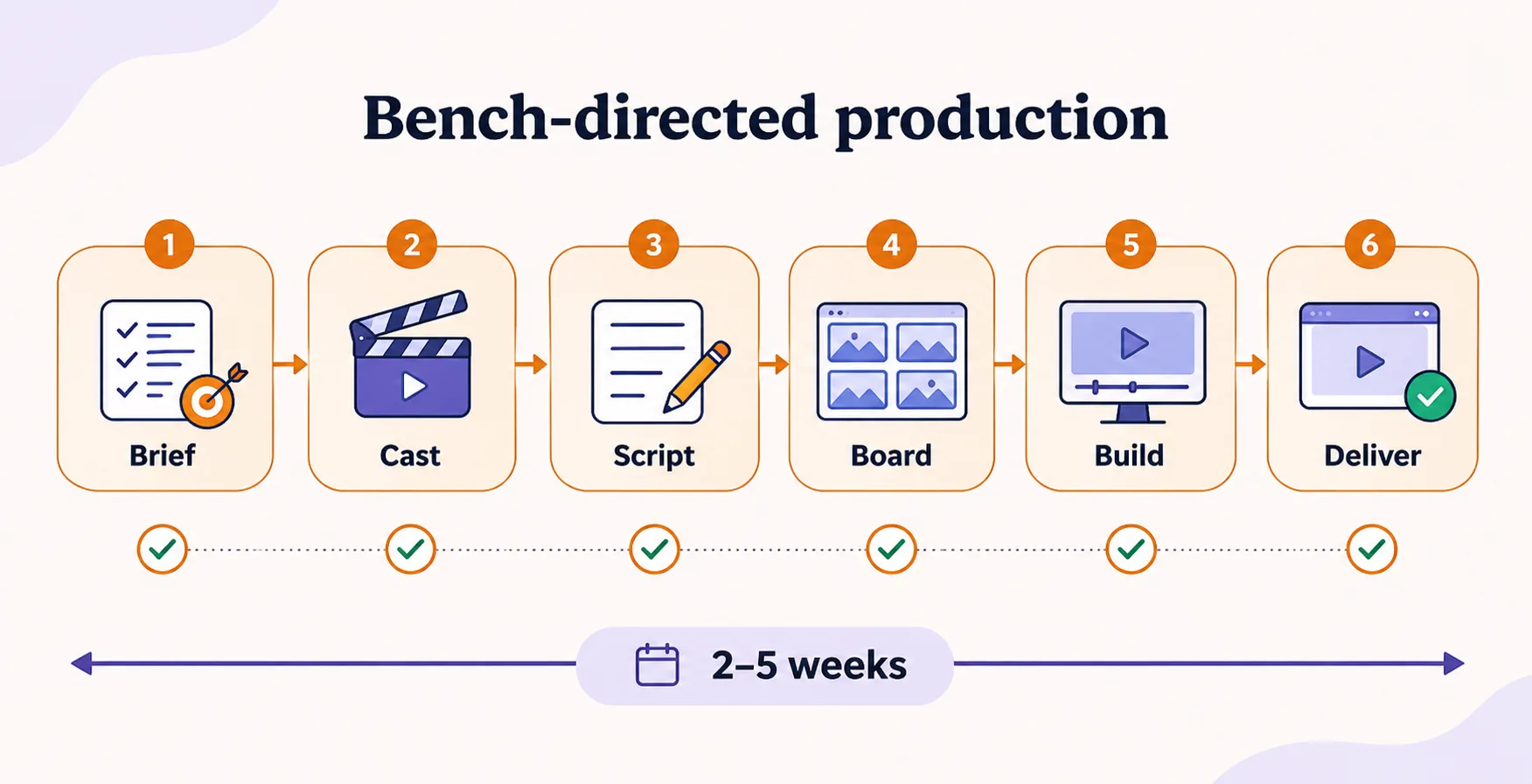
A bench-directed production runs through six stages, and no stage starts before the previous one closes. Here is what happens in each.
Brief: A call, followed by a written brief the same week. The brief names what the video is competing against and who has to approve it. Naming the approvers at the start matters because a late approver is the most common source of rewrites.
Cast: A director, animator, and editor are assigned from a vetted bench, chosen for this brief rather than because they happen to be free. A product demo and a brand film need different strengths, and casting is where that difference gets handled.
Script: Two rounds of revision, written against sales calls and positioning rather than a feature list, and approved before anything moves to storyboard. Fixing a line of script costs almost nothing. Fixing the same line after animation is built costs a lot.
Board: Style frames and a timed storyboard, approved before a single frame is built or a crew is booked. This is the last cheap point to change the look and the pacing.
Build: Production or animation, sound design, grade, and mix. A rough cut is shared partway through, so notes land while they are still inexpensive to act on.
Deliver: The master file, cutdowns, captions, and source project files, with ownership transferring the moment the video ships.
On our own bench, drawn from a partner roster of more than 40 directors, animators, and editors, the six-stage process runs two to five weeks end to end. It closes with every source file handed over, not just a rendered export.
The structure is built around approvals. Each stage ends with a person saying yes before the next one begins, which is why the process is slower and also why it is hard to derail.
7 Ways Agentic and Traditional Video Production Differ in 2026
The two models differ most in where the work, the cost, and the risk sit. The seven comparisons below run from timeline and cost to rights and maintenance, and each ends with a note on what it means for your project. Read them as trade-offs, since the right answer depends on the video you need to make.
1. Timeline: Hours for Agentic, Weeks for Traditional
Most of a bench production's two-to-five-week timeline is queue time rather than decision time. The project waits on a casting slot, a script round, or a storyboard review.
Agentic production removes much of that waiting without removing the stages. An agent can research, draft, and build a first cut in an afternoon by running those steps back to back. You still review the script and approve the equivalent of a storyboard before a full render. The wait moves from a producer's calendar to your own review time.
What it means for you: If the deadline is days away, agentic production is often the only realistic option. If the deadline is weeks away, the time saved matters less than the quality of the result.
2. Cost: A Project Fee vs. a One-Time License
A studio-produced video is a project fee, paid once for a finished file. These are AllCapStudio's current prices:
Video type | Project fee |
|---|---|
Product demo | $2,800 |
Explainer | $3,400 |
Brand film | $9,000 |
Agentic tools invert that structure. CoAnimator's free tier renders locally with unlimited exports, and a one-time license removes the watermark and unlocks 4K. There is no per-video fee, because the license is paid once rather than per project.
The invoice is only part of the cost, though. The coding agent you connect carries its own subscription or usage charges, and the hours you spend directing and reviewing the agent's work are real time from someone on your team. Agentic production moves the cost from a fee to a mix of tooling and attention.
What it means for you: If you will make one video, a project fee is easy to budget. If you will make many versions of similar videos, a one-time license spreads very thinly across them.
3. Direction: A Producer and Cast vs. a Prompt and an Agent
On a bench-based production, direction runs through people. We cast each project from our partner bench, matching a director, animator, and editor to the brief. Notes go to a person, who interprets them with judgment.
On agentic production, direction runs through your prompt and whichever coding agent is connected. The quality of the result depends on how clearly you describe what you want. It also depends on the agent itself. Swap Claude Code for Codex on the same project and the output can shift, since the sequencing logic lives in the agent, not in the video tool.
What it means for you: A person can ask what you meant and push back when a note will not work. An agent follows the instruction it was given, so the clarity of your direction matters more.
4. Output Quality: Who Does the Finishing
A bench-directed video gets a dedicated sound designer and colorist in the Build stage. Audio, color, and pacing are checked by a specialist before delivery, so there is a second pair of eyes on the details a viewer feels but cannot name.
Agentic tools produce clean results quickly, but finishing beyond the first render sits with you. CoAnimator ships a built-in text-to-speech plugin and handles sound, but a colorist's eye is not part of the software. If the video needs a specific mood, a balanced mix, or careful pacing for a high-stakes audience, someone on your side has to catch what the agent misses.
What it means for you: For internal demos and tutorials, clean output is usually enough. For a video that represents your brand to new customers, the finishing pass is where a specialist earns the fee.
5. Scalability: Unlimited Renders vs. a Dedicated Service Line
A bench scales through a dedicated service line, priced and staffed for volume, because testing several cuts is a different job from producing a single flagship film.
Agentic production scales differently. Rendering ten versions costs nothing beyond the first build, since local exports are unlimited. Each version still needs its own prompt and its own review, so your time scales even when the render cost does not.
Revisions follow the same pattern. A bench revision means booking another round inside the scope you paid for. An agentic revision means running the agent again, which is faster to execute but puts the review work back on you every time.
What it means for you: Agentic production is strong when you need many variations of the same idea. A production team is strong when you need one version to be right.
6. Rights and Clearance: Who Checks the Licensing
A bench-directed production transfers full ownership on delivery: the master file, the source project, and every licensed asset. Clearing music, stock, and talent releases is part of the Deliver stage, so you receive a video that is ready to run.
Agentic production leaves rights review with you. CoAnimator, for instance, lets generators such as Google Veo or HeyGen plug into a project the way stock footage would. Nobody but you checks their commercial-use terms before the video ships, so a clip that looks fine can still carry usage limits you did not read.
Rights and clearance is a separate question from disclosing AI involvement. Clearance asks whether an asset is legally usable. Disclosure asks whether the viewer is told how it was made.
What it means for you: If a video will run as a paid ad or sit inside a legal or brand review, decide who owns the licensing check before the build starts.
7. Maintenance: Reshoot vs. Rebuild
A traditional video is a finished asset. When a product's interface changes six months later, updating the demo means booking a new session, not opening a file.
Agentic production keeps the video as project files. A UI change becomes a rebuilt scene and a re-render, not a new shoot. A team can return weeks later, change one scene, and export again without disturbing the rest.
This is the biggest structural change to watch in 2026. A video stops being a finished file and becomes a project you maintain, much like code.
What it means for you: The more often your product changes, the more the maintenance difference matters. A video that will stay accurate for a year gets little from it.
What Doesn't Change in Either Production Model
Three things stay the same whichever model builds the video.
Creative Judgment Stays a Person's Call
Pacing, whether a joke lands, and whether the script argues the right point at all are decisions a person makes, whichever production model builds the file. We use generative tools for first-pass scripts, storyboard frames, and clean-up because they are faster at those jobs. Directing a performance and deciding what a video should argue stay with people on every project we run.
AI Disclosure Does Not Change
Where AI-generated footage appears in a video we deliver, we say so in the handover. Once the video ships, it carries the client's brand, so the client needs to know what is in it. That habit does not depend on which agent built the scene. It is a rule about what a viewer is owed, not a technical limitation.
A Weak Brief Is Still a Weak Brief
An agent given a vague instruction fills the gap with a plausible guess, the same way an inexperienced editor does. Plausible is not the same as right, and the guess is often hard to spot until the video is built.
The script runtime calculator catches one common version of this before an agent or a crew starts work: a script that reads fine on paper but runs four minutes when the brief called for ninety seconds. Fixing a brief takes minutes, and fixing a finished video takes much longer.
Agentic vs Traditional Video Production: Side-by-Side Comparison
Question | Agentic production | A production bench |
|---|---|---|
Timeline | Hours to a first cut, review still required | Two to five weeks, stage by stage |
Best for | Demos and tutorials that go stale and need rebuilding often | A brand film or launch video that has to carry weight once |
Direction comes from | A prompt and whichever coding agent is connected | A producer and a cast picked for the brief |
Cost shape | Free to start, a one-time license for clean exports, plus the cost of the coding agent | A fixed project fee per finished video |
Consistency comes from | A project file and the agent's instructions | A director and colorist checking every frame |
Scaling to volume | Unlimited renders, extra prompt time per version | A dedicated service line, priced and staffed for it |
Rights and clearance | Left to you, including third-party generators plugged into a project | Cleared as part of delivery, music, stock, and talent releases included |
What you get back | A project file you rebuild yourself | A finished master, source files, and ownership transferred |
Combining Agentic and Traditional Video Production
Most real projects do not pick one model. They split the work by stage, with an agent doing the fast, repeatable parts and a person making the decisions that matter.
On a bench-directed project, agentic tools already handle some work inside stages that a producer still owns. A first-pass script draft comes back overnight instead of after a week of research. Storyboard frames get roughed out quickly enough for a director to react before committing real time to them. Rough assembly and B-roll clean-up happen before an editor's first pass, not instead of it.
Stage | Where an agent can help | Who signs off |
|---|---|---|
Brief | Summarizing sales calls and existing positioning | Producer and client |
Script | A first-pass draft ahead of revision rounds | Producer |
Board | Roughed-out storyboard frames | Director |
Build | Rough assembly and B-roll clean-up before the editor's first pass | Editor and director |
Deliver | Captions and cutdowns | Producer |
As an illustration, imagine a software company with a flagship brand film and a product demo that changes every quarter. The brand film goes through a full bench production, because it has to be right once and will run for a year. The demo is built and maintained with an agent, so each product update becomes a scene rebuild rather than a new project. Both videos share the same script and positioning work, and each is made the way that fits how long it will live.
What does not move to the agent is the check at the end of each stage. The Script stage still closes on a producer's approval, and the Board stage still needs a director's eye before a crew is booked. Combining the two models does not mean a 50/50 split between tools and people. It means a person still signs off on every stage an agent touched.
How to Choose Between Agentic and Traditional Video Production
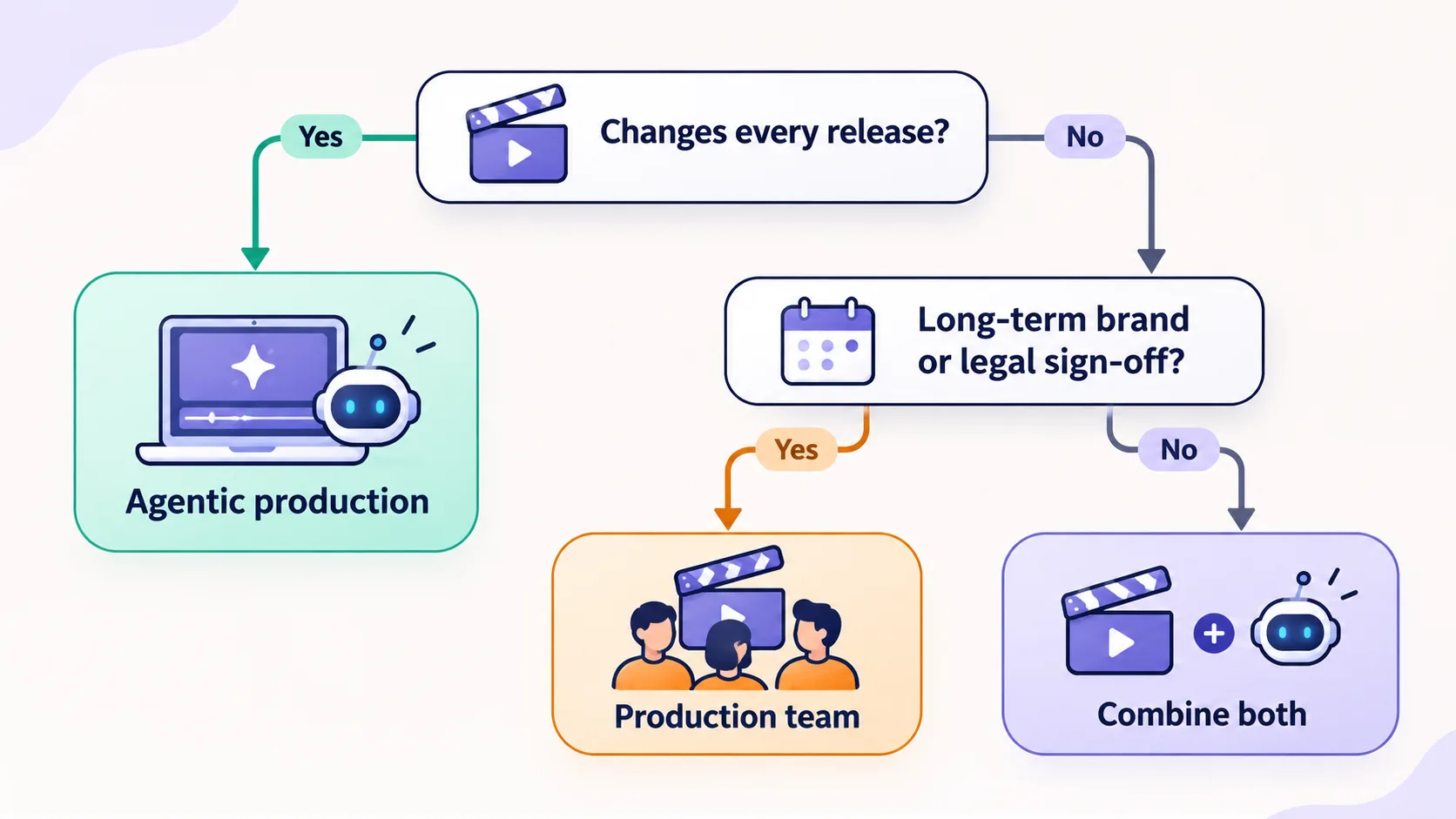
Five checks settle most of the decision before a frame gets built.
Update frequency: A demo or tutorial that changes with every product release earns back a one-time license quickly, because each update is a scene rebuild. Something you will run unchanged for a year rewards the weeks a producer spends on the cast and the script, since those choices will not be revisited.
What is riding on it: Animation and motion work, where a single visual idea has to carry an entire pitch, still rewards a director who has done it before. An agent's first pass at that format is a draft, not a finished idea.
Who signs off: If legal, brand, or leadership review sits between a draft and publishing, a producer who owns the outcome and documents AI disclosure is worth the fee. That applies most to a brand film.
In-house agent literacy: Agentic production assumes someone on your team already directs a coding agent day to day. Without that person, you pay in your own hours what you save on the license.
Volume: A single flagship film and a running stream of vertical cuts for paid social are different jobs, and pricing them the same way is how budgets go wrong. A weekly stream usually needs an ongoing operation, closer to what an AI marketing agent runs than a single shoot.
If your video is... | Lean toward |
|---|---|
A demo or tutorial that changes every release | Agentic production |
A brand film or launch video that runs for a year | A production team |
A weekly stream of short cuts for paid social | An ongoing operation, with agentic tools for volume |
Subject to legal or brand review | A production team, or agentic production with a named owner for clearance |
If two or three of these checks point in different directions, that is a sign to split the project by stage, as described above.
The Decision Moves Earlier, Not Away
Agentic production does not remove the moment when someone has to decide that a video is right. It moves that moment earlier, into the prompt and the first review, instead of leaving it for a shoot day or a client screening months into a project.
That is a real gain for a demo or tutorial rebuilt every quarter. A scene that used to need a new session now needs a prompt and a render, and the video stays current with the product. For a brand film that a company runs once and needs to be right the first time, the gain is smaller. The biggest decisions there still happen in a script meeting and a cast list, not in a render queue.
Here is what you need to do:
Choose agentic production when the video changes often, when you have someone who can direct an agent, and when you can own the review and the rights check.
Choose a production team when the video has to be right once, when several people must approve it, and when someone needs to be accountable for the result.
Combine them when a project has both kinds of work, and keep a person signing off on every stage an agent touches.
We build videos with a producer who owns that decision from the brief to delivery, rather than an agent's settings. If your next video is a product demo, a brand film, or a launch video that needs someone accountable for the result, write up a brief and a producer replies within a week with a scope, a price, and a schedule.
Written by the AllCapStudio team. We publish what we would tell you on a call, which occasionally costs us the project.
Read next
All articles- Journal6 Best HeyGen Alternatives in 2026, Compared by Price, Limits and FitCompare 6 HeyGen alternatives for 2026 by price, free plans, limits and fit, including Synthesia, CoAnimator, Colossyan, D-ID…
- JournalHow to Choose a Product Video Production Agency for Your Product TeamShortlist a product video production agency with five checks, real price ranges and a 100-point scoring sheet built for SaaS…
- Journal7 Best Auto Caption Generators for Video in 2026Compare the 7 best auto caption generators for video in 2026, with annual pricing, accuracy limits, burn-in vs SRT, and the best…