Journal11 min read
What Animated Explainer Videos Actually Cost (Real Pricing)
Building an animated explainer video looks straightforward until you start pricing it. A founder needs ninety seconds that make a stranger understand the…
- Published
- Updated
- Written by
- AllCapStudio

Building an animated explainer video looks simple, right up until you get a quote. A founder needs ninety seconds to make a stranger understand the product, and the search for who builds it turns up production studios, freelancers, and a growing set of AI-assisted animation tools promising to cut both the timeline and the bill. Every option sounds confident, and the 2026 prices we checked for the same 60 to 90 second brief disagree by roughly ninety-five times.
We break down animated explainer video pricing across the three routes people pay through—a studio, a freelancer, and software and why none of the three ever mentions the other two. Each route also counts a different unit, per project, per finished minute, or per year of software, so we put every price on a per-video basis. We stay inside animated work, leaving out the live-action and screen-recorded explainers turning up in the same searches.
What Does Each Animation Pricing Option Include?
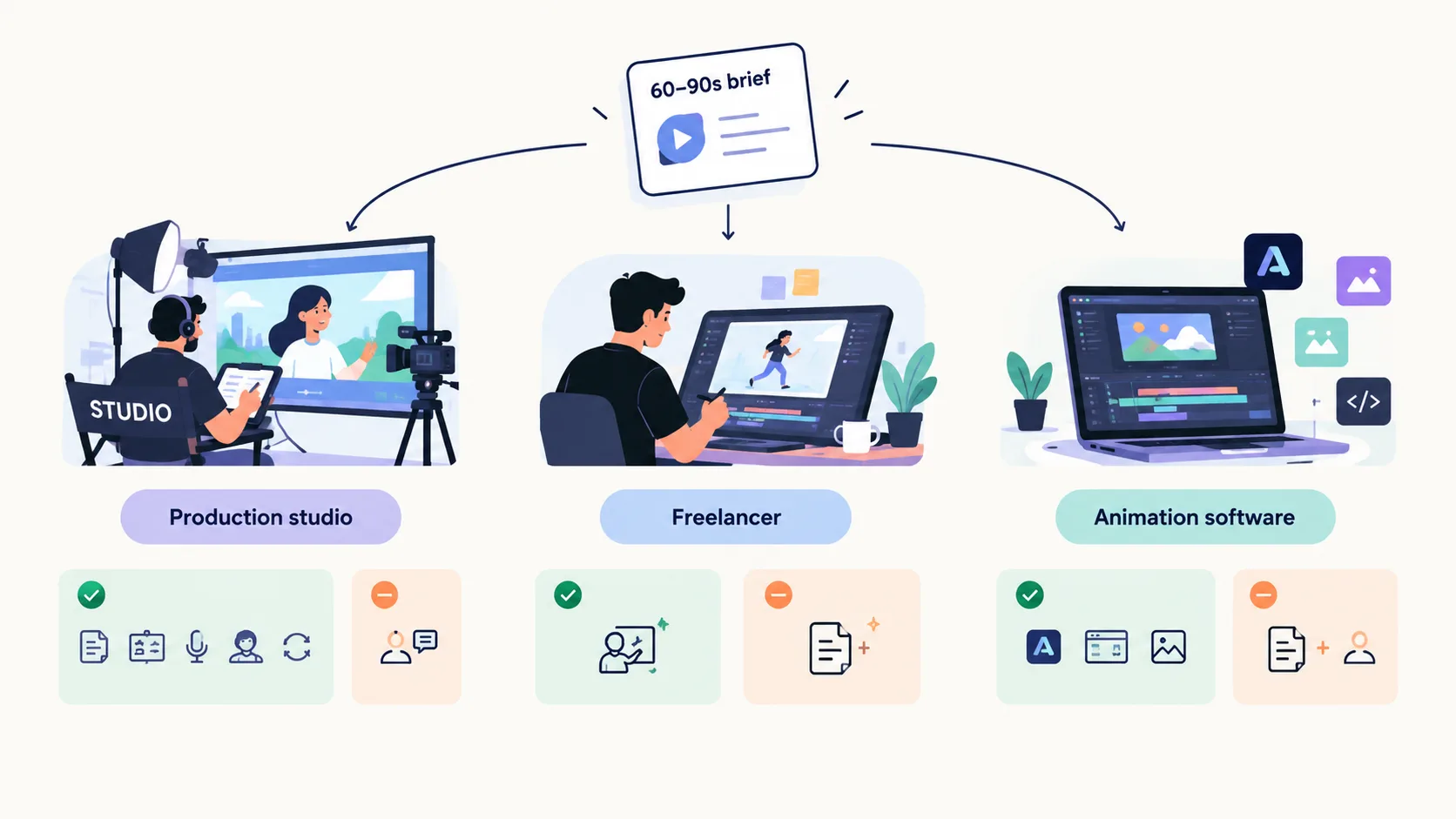
Each route covers a different share of the labor on the same 60 to 90 second brief, which explains most of the price gap before craft enters. The table shows what the price includes and what you still supply.
Route | Included in the price | Left to you |
|---|---|---|
Production studio | Script, storyboard, cast voice, custom animation, managed revisions | Your brief, approvals, and feedback |
Freelancer | One animator's production time | Usually the script, with extras priced separately |
Animation software | The tool, templates, and stock or agent-built scenes | Script, storyboard, voice, and the hours to assemble the video |
Studios carry the most labor inside one invoice, spread across six production stages from brief to delivery, which makes their published ranges the right starting benchmark for your budget.
Animated Explainer Video Studio Pricing in 2026
Animated explainer video production companies and rate guides publish their prices openly, and we found seven 2026 sources quoting a range for a 60 to 90 second video. We computed medians across the seven floors and the seven ceilings, so no single studio sets your benchmark.
Source | Source type | Published range | Date |
|---|---|---|---|
Studio | $5,000 to $20,000 | Page updated July 21, 2026 | |
Subscription studio | $5,000 to $15,000 | 2026 | |
Studio | $5,000 to $15,000 | 2026 | |
Studio | $5,000 to $15,000 | Updated June 17, 2026 | |
Studio | $3,000 to $10,000 | 2026 | |
Industry rate guide | $3,000 to $10,000 | March 13, 2026 | |
Studio | $3,000 to $15,000 | 2026 | |
Median of the seven | $5,000 to $15,000 | Computed October 15, 2026 |
We price a 60 to 90 second explainer from $3,400 and a 90-second 2D explainer at $6,000 to $9,000 on a published rate card, and the $6,000 to $9,000 range sits inside the median band. We left our rates out of the medians because a first-party figure should not set its own benchmark. We also built a 78-second 2D explainer for a payments API in the same length range.
Advids surveyed 80 clients and 12 agencies in 2025 and reported an average of $2,966 for a 60-second animated explainer, below every floor in the table. Treat the survey as a reality check on what clients paid.
All seven sources are vendors with a commercial interest, so read the medians as published asking ranges. Next, we break one quote into line items to show where your money goes.
Animated Explainer Video Cost Breakdown
Studio invoices bundle six kinds of work, and the split shows where the budget lands. We priced a 75-second explainer in 2D motion graphics with a cast voice and four cutdowns at our published rates, and the explainer video cost comes to $9,200.
Line item | Cost | Share of total |
|---|---|---|
Discovery and script, two drafts | $1,400 | 15% |
Style frames and storyboard | $1,100 | 12% |
Voice casting and recording | $450 | 5% |
Animation, 75 seconds | $4,900 | 53% |
Sound design and music licence | $600 | 7% |
Cutdowns, 30s and 15s plus 9:16 and 1:1 crops | $750 | 8% |
Total | $9,200 | 100% |
Script and storyboard together take 27 percent, spent before any frame moves. Cutdowns earn a line of their own because each platform wants its own length and aspect ratio. On our rate card, character animation and 3D cost two to four times the per-minute price of motion graphics, and rush schedules add 25 percent.
Character design and rigging are why animated work costs more than a screen-recorded product demo, which skips both. Because the rig underlies every scene, a redesign after storyboard approval reopens the whole phase of character animation, so lock the character before you approve the storyboard.
Freelance Animated Explainer Video Costs in 2026
Expect freelance pricing to split into marketplace gigs and professional animators, two groups differing by a factor of four or more. The table sets marketplace averages beside professional medians and the open Upwork postings we checked.
Measure | Figure | Source |
|---|---|---|
Average animated explainer listing | $210.87 (about $211) | Fiverr, August 2026 |
Hourly marketplace work | $37 to $50 | Fiverr, August 2026 |
Typical 60-second marketplace explainer | $200 to $400 | Fiverr, August 2026 |
Professional freelancer, median of four guides | $850 to $3,500 | AllCapStudio, Jobbers, Vidico, Pexo |
Open Upwork postings for 30 to 60 second animations | $100 fixed or $20 to $50 an hour | Three postings, September to October 2026 |
Add three costs to the marketplace average, all itemized in the same Fiverr guide.
Voiceover: Recording adds $50 to $300 depending on script length and voice.
Source files: Editable project files often add 20 to 30 percent of the project fee.
Rush delivery: Faster turnaround typically adds 20 to 50 percent to the standard price.
Add the guide's midpoint voiceover of $175 and a 25 percent source-file fee, and a $211 listing becomes about $439 before any storyboard stage. The professional range exists because you pay for the animator's judgment as well as the animation once you need a script, a style reference, and a second revision round.
Animated Explainer Video Software Pricing in 2026
We checked four animation tools against their own pricing pages. The table lists limits, and each entry after it carries the price.
Tool | Free-plan limits | Entry paid plan limits | AI allowance |
|---|---|---|---|
Vyond | Free trial, no free plan | 25-minute videos, 1080p, 100 downloads a month | 10,000 credits a month |
Powtoon | 720p, 3 minutes, watermark | 10 minutes, 1080p, watermark removed on 5 exports a month | 300 credits a year |
CoAnimator | 720p with watermark, unmetered local renders | 4K and watermark-free exports on 2 devices | Uses the buyer's own coding agent, no credits |
Steve AI | Free plan with 5 voice-overs listed | 720p, unlimited exports, 100 or more characters | 100 minutes of AI video a month |
1. Vyond Pricing and Features
Vyond is a browser-based animation platform built around character templates, a scene editor, and its Vyond Go AI video generator. Professional adds translation into 95 languages and Shutterstock stock media. One Vyond Go generation costs 800 credits, which allows about twelve generations a month on Starter. Starter runs $699 a year for one user and Enterprise climbs to $1,649 a year per user.
2. Powtoon Pricing and Features
Powtoon is a browser-based animation and presentation tool with templates, characters, and an AI credit system covering video generation, voiceover, and avatars. Professional adds unlimited premium exports and 20-minute videos. A year of Lite credits covers roughly twelve to twenty silent AI clips of five to eight seconds or fifteen minutes of avatar lip-sync. Lite sits at $180 a year billed annually, and extra credits cost $49 for 125, $99 for 300, or $149 for 450.
3. CoAnimator Pricing and Features
CoAnimator is an agentic animation studio where an AI coding agent such as Claude Code, Codex, Antigravity, or OpenClaw builds the scenes, timeline, and narration from a written brief. Projects stay as editable files, so one scene can change without rebuilding the video. It suits teams directing video through a coding agent they already pay for, and the agent subscription sits outside the license price. The Free forever plan costs nothing, and the sole paid option is a lifetime license.
4. Steve AI Pricing and Features
Steve AI is a browser-based script-to-video generator from the makers of Animaker, built on a stock cast of animated characters and an asset library. Resolution rises to 1080p on Starter and 2K on Pro, with 4K reserved for custom-priced Enterprise plans. Scenes come from the library rather than a custom storyboard, so teams needing a brand-specific character often compare Steve AI alternatives or commission a separate build. Basic runs $120 a year billed annually, with Enterprise priced on request.
Cost Per Video at Different Production Volumes
An annual plan spreads one fixed fee across every video you make. We held the studio floor, the professional freelance floor, and the marketplace average from the earlier sections constant per video and divided a $480 annual plan, the price of Powtoon Professional or Steve AI Pro, by the video count.
The last column adds eight hours of your own time at $50 an hour per video. Both figures are our assumptions, with $50 set at the top of Fiverr's published hourly band, so replace them with your team's numbers.
Videos per year | Studio, per video | Professional freelancer, per video | Marketplace gig, per video | $480 software plan, per video | Software plan plus own time, per video |
|---|---|---|---|---|---|
1 | $5,000 | $850 | $211 | $480 | $880 |
4 | $5,000 | $850 | $211 | $120 | $520 |
12 | $5,000 | $850 | $211 | $40 | $440 |
24 | $5,000 | $850 | $211 | $20 | $420 |
Annual totals for twelve videos are $60,000 at a studio, $10,200 from a professional freelancer, $2,532 from marketplace gigs, and $480 for the plan or $5,280 with your own time priced in. Software plus your own time costs $880 for one video against an $850 freelance floor and $640 for two, so the plan undercuts a professional freelancer from the second video.
A $480 plan falls below $100 for a video at five videos a year, and Vyond's $699 Starter plan does so at seven. The comparison holds when a template and stock cast meet your quality bar. A $99 CoAnimator license works out to $99, $25, $8, and $4 for a video across the same four volumes in the first year, before the cost of the coding agent you already pay for.
AI Animation Credits and Subscription Pricing
Two pricing models appear across the 2026 pages we checked, credits on the software side and monthly subscriptions on the studio side, and both change how you should read the figures.
Credit metering: Powtoon's extra packs work out to roughly $0.33 to $0.39 a credit, and Vyond meters its AI generator the same way against a monthly allowance.
Studio subscriptions: Shootsta lists plans from US$1,000 a month and MotionCue sells a subscription tier with unlimited requests, while Video Editing Company's own math puts the break-even against per-project pricing at four to six videos a quarter for its $5,000 to $16,000 monthly retainers.
Credit allowances make a software plan's cost depend on how much AI generation each video uses, so a plan price alone no longer fixes your per-video cost. Subscription studios price volume directly, so the flat studio line in the cost model is the per-project case.
Studio vs Freelancer vs Software: Which Costs Less?
Software costs less than a studio at every volume we modeled and less than a professional freelancer after the first video. CoAnimator's one-time $99 lifetime license is the lowest entry price of the four tools compared, with Vyond's $699 a year the highest. Three patterns map the numbers to a route.
One or two films a year: Hire a studio for a homepage hero, a funding announcement, or a brand film where one video carries the pipeline. Studio-built animated explainers earn the higher price when a wrong tone costs more than the invoice.
Three to six custom pieces: Brief a freelancer once you hold a validated script, a style reference, and a storyboard built from storyboard templates, and run the script through a runtime calculator to catch an overlong draft before the animator does.
A video every release cycle: Buy an annual software plan or the lifetime license once your volume passes the break-even in the cost model, provided the script and voice come from your team. Pick a studio instead for product demo videos needing a written script and a cast voice, which no software plan supplies.
Each pattern assumes your quality bar matches the route. When you move from a first-launch film to weekly release videos, change the route at the moment the volume rises instead of stretching the first one.
Choosing the Right Animation Production Budget
Expect software vendors to quote credits per finished minute and studios to quote a delivered-video count inside a subscription by the next pricing review. Either number slots into the cost model in place of the plan price, so ask for it in your next round of quotes.
We quote animated explainers against our published rate card with the video count written into the scope, so a one-off film and a monthly release cadence each get a price built for their volume. Send us a brief stating how many videos your next twelve months need, and the written quote arrives with the assumptions listed, usually within two working days.
Written by the AllCapStudio team. We publish what we would tell you on a call, which occasionally costs us the project.
Read next
All articles- Journal7 Best Cardboard AI Alternatives for Video EditingWe tested 7 Cardboard AI alternatives for editing, clipping, and building video, comparing pricing and who each tool best fits.
- Journal9 Best Text-to-Video AI Generators Compared (2026)Compare 9 text-to-video AI generators for 2026, including pricing, native audio support, and which tool fits your video needs.
- JournalHow Long Video Production Actually Takes, Stage by StageSee how long video production takes by stage, format and company size, from a one-week simple video to a nine-week brand film, and…