Journal15 min read
Brand Video Examples and What Makes a Brand Film Work
Brand video examples from Dollar Shave Club, Volvo, Apple and Patagonia, broken down by hook, format and purpose, plus what makes a brand film work.
- Published
- Updated
- Written by
- AllCapStudio

Brand films are the most expensive format we produce, and the decisions that decide whether one works get made before anyone picks up a camera. If you cannot say what your film argues, what proves it and how it opens, the brief stays vague, the film comes back generic, and you cannot tell afterward whether it worked.
Studying brand video examples is the usual fix, but a finished film hides those decisions. This guide breaks six documented films down by hook, format and purpose so you can see the choices behind each result, then shows you how to make the same choices for your own project. The analysis draws on press releases, trade coverage and case studies, plus our own production process.
We produce brand films and paid social ad batches, so the guide also shows how one film idea becomes testable ads.
Brand Film vs Ad vs Corporate Video
A brand film is a narrative video made to be remembered. "Brand video" is the wider term for any short, narrative-driven marketing video that shows a brand's values, promotes its products, or both, and a brand film is the longer, more cinematic end of that range. Two other formats get confused with it. An ad has to win attention from people about to scroll away. A corporate video informs, with recruiting, internal training and investor updates as typical subjects.
The three differ in what you judge them on. The table also shows the runtimes we publish for our brand films and video ads.
Brand film | Ad | Corporate video | |
|---|---|---|---|
Job | Be remembered | Get acted on | Inform |
Our runtime | 90 seconds to 4 minutes | 6 to 45 seconds | Set by the use |
Judged on | Brand lift, recall, internal shares | Cost per acquisition | Whether the audience got the information |
Pin down three terms before you read on. Cost per acquisition is the amount each new customer costs you. Brand lift is the change in awareness, perception or interest among people who saw your video, the brand metrics that Google's Brand Lift studies report in Think with Google's 2015 paper on measuring online video. Recall is whether viewers remember seeing it. Both come from viewer surveys and not from platform dashboards, so you have to run a study to get them.
What Makes a Brand Film Successful
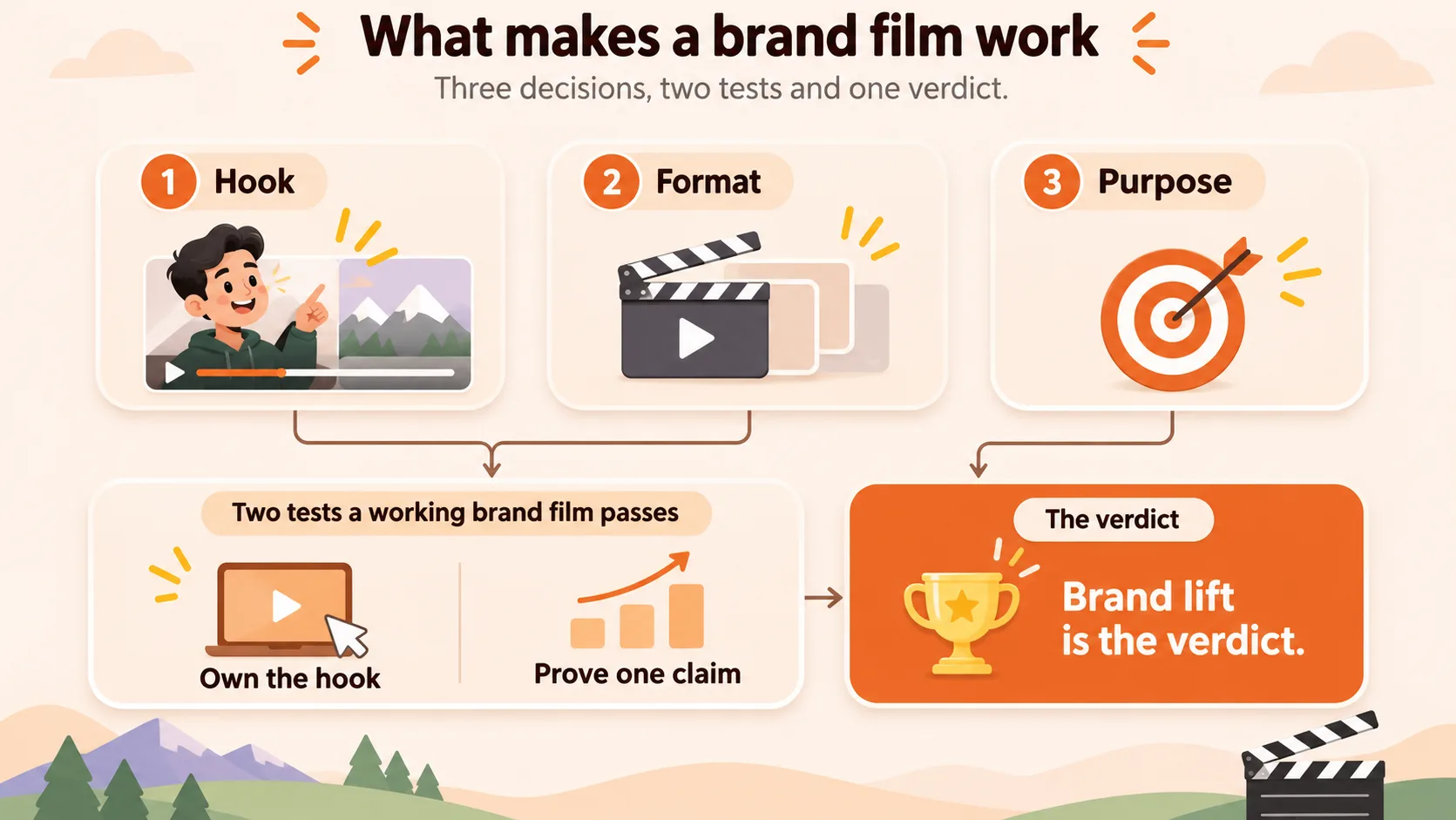
Every brand film that works comes down to three choices, and you should be able to name all three for any film you commission. Write them down for your own project before you judge anyone else's.
The hook is whatever earns the viewer's next few seconds. It can be a first frame, a first line, an unexpected setting or a release date. Your placement sets the deadline. TikTok's Creative best practices for performance ads page, last updated in June 2025, says to prioritize your hook in the first 6 seconds and introduce your content proposition in the first 3. A three-minute film can open slowly. Your 15-second ad cannot.
You can also test your opening. Think with Google's paper reports that Mondelez ran two versions of the same Trident Unlimited spot. In one the actor puts gum in his mouth at the start, and in the other he is already chewing. A brand lift study showed the second version had a 5 percent higher recall rate.
The format is how you structure and produce the film. A founder speaking to camera, a staged stunt, customer-sourced footage, a documentary, a narrated montage and a scripted comedy are all formats. Your format decides who you hire. We cast a documentary founder piece and a stylised commercial with different directors, because the two need different skills behind the camera.
The purpose is the one thing you want the film to change, such as sign-ups, belief in a claim or the way people describe your company. Choose your metric from it, and choose one purpose per film so your hook and your format point the same way.
Two Tests Every Brand Film Should Pass
Own the hook: Swap a competitor's logo onto your opening. If the competitor could run it unchanged, your hook is unfinished. Each of the six films below uses a different type of hook, and none of them could belong to another brand.
Commit to one claim and show its proof: The proof can be a founder, a product, customers, athletes or statistics, as the examples below show. A film that tries to cover your whole company gives viewers nothing specific to repeat, so choose your claim and your proof first and write everything else around them.
How to Measure Brand Film Performance
Be careful with completion metrics. View-through rate shows whether a film holds attention, and it can mislead you. In Think with Google's paper, YouTube's Global Media Lead Maria Chai says that videos with higher view-through rates did not always correlate to a lift in brand metrics. Treat completion as a diagnostic and brand lift as your verdict. The paper dates from 2015, and the logic applies to any film built to change perception.
6 Brand Video Examples and What Makes Them Work
These six brand film examples each represent a different format and have a documented public record. Read each one against the three decisions and the two tests above. Five of the six launched between 2012 and 2018, so use them to learn how formats work and expect platform tactics to have moved on. The ads section later in this guide covers current guidance.
1. Dollar Shave Club – Founder-Led Brand Video
Michael Dubin pitches razor blades by subscription straight to camera.
Hook: The opening line. Entrepreneur's reporting says Dubin wanted the first punch to land hard and was stuck until Aniello supplied the line that became the film's trademark ("Our Blades Are F***ing Great").
Format: Founder to camera, built around a line written to land first.
Purpose: Launch a subscription business to people who had never heard of it. Entrepreneur counts about 12,000 sign-ups in the first 48 hours, with no marketing beyond some Google ads.
What you can copy: Write your first line so it carries your brand's attitude, then build the rest of the film around it. A founder film does not need a long shoot either. Our Field & Form founder film was shot across two counties in a day and a half. If you want a founder piece planned that way, we can scope it.
What you cannot copy: A launch film that works creates demand you have to fulfill. Plan fulfillment for the reach you hope to get.
2. Volvo Trucks – Product Demonstration Through Spectacle
Jean-Claude Van Damme performs a split between two reversing trucks to demonstrate the precision of Volvo's steering.
Hook: A calm face and a reveal. The camera pulls back to show what he is standing on, and the claim lands before anyone explains it.
Format: A single-take stunt that Fast Company reports was the sixth film in Volvo's "Live Test" series. Each film demonstrated one product claim.
Purpose: Prove one technical claim to truck buyers. Volvo Trucks' own Cannes release reports more than 73 million YouTube views at the time of the 2014 awards, where the campaign won Grand Prix awards in Film and Cyber.
What you can copy: Build a series so each film proves one claim and none has to carry them all. Fast Company adds that the product relevance of each stunt eased internal worry that the campaign was frivolous, which is worth remembering when you pitch a stunt to your own team.
What you cannot copy: The celebrity, the closed road and the safety planning.
3. Apple – User-Generated Content Campaign
Apple curated photographs taken on the iPhone 6 by users and photographers around the world and ran them as billboards, print and transit ads.
Hook: The image itself, carrying only a short tagline. The product's output does the persuading.
Format: UGC, which is content made by customers or creators instead of the brand's own crew. MacRumors reports a worldwide campaign involving 77 photographers across 70 cities and 24 countries that began with a gallery on Apple's homepage before the images moved outdoors.
Purpose: Prove camera quality with work real owners made. The campaign won the Cannes Lions Outdoor Grand Prix.
What you can copy: Let your customers' work be the creative, and settle usage rights before anything runs.
What you cannot copy: Apple chose photographers whose work already showed the product at its best, and its reach put the images in 70 cities. Without that reach, you will have to brief and pay creators directly.
4. Patagonia – Customer Storytelling Documentary
A film about the stories attached to gear that people have kept and repaired.
Hook: The release date. Patagonia's own announcement says the film was released as an antidote to the Black Friday and Cyber Monday shopping rush, so the timing made the argument before the first frame.
Format: A documentary built on real customers, with an invitation on the same page for viewers to submit their own stories.
Purpose: Express a value, which is making things last, and support a repair program.
What you can copy: Choose your release date as deliberately as your cut.
What you cannot copy: Years of consistent action sit behind the film. If your brand lacks that record, you can borrow the format, but viewers will check your claim against what you actually do.
5. Nike – Brand Manifesto Video
A two-minute spot narrated by Colin Kaepernick.
Hook: A narrator and a stated belief.
Format: A narrated montage. The Guardian's report on the film notes it also featured athletes including LeBron James and Serena Williams and won the Emmy for outstanding commercial.
Purpose: Restate what the brand stands for.
What you can copy: Take a position your company will keep acting on after the film ends. The same coverage records public backlash, including videos of people burning Nike products, so decide before you shoot how much of that you can carry. A manifesto polarizes by design.
What you cannot copy: The media buy and the roster of athletes.
6. Who Gives a Crap – Brand Video Through Humor
A comedic script about toilet paper that also explains the brand's mission.
Hook: Humor is the way in. Shopify's review says the script discusses the product and communicates the brand's core message at the same time.
Format: Scripted comedy with statistics about the environmental impact of the toilet paper industry worked into the jokes.
Purpose: Make a values-led product memorable. Shopify notes the company donates 50 percent of its profits to sanitation development.
What you can copy: Put your facts inside the joke, so the laugh carries the information.
What you cannot copy: The humor. It works because it matches the company's real voice, and a borrowed comic style reads as borrowed.

Which Brand Video Format Fits Your Marketing Goals?
Each of the six films answers a different situation, so match the type to yours and ignore examples you merely admire. The next-to-last column shows the closest format we build.
Your situation | Type to consider | Example | Closest format we build | Judge it on |
|---|---|---|---|---|
Launching with little awareness, and the founder is a credible voice | Founder-led | Dollar Shave Club | Founder story film or founder-led ad | Sign-ups and orders |
Buyers doubt one specific claim | Product proof | Volvo Trucks | Commercial video | Recall and brand interest |
Customers already make good content | Customer content | Apple | Creator UGC ad | Engagement and conversion where it runs |
Customers have stories that carry a value | Customer story | Patagonia | Customer film | Completion and shares |
A rebrand or funding announcement needs a stated position | Manifesto | Nike | Manifesto film | Brand lift |
The brand's voice is comic and the product needs explaining | Humor and education | Who Gives a Crap | Commercial video | Shares and recall |
Founder-led appears as both a film and an ad because your founder can carry a three-minute film or a 20-second test.
If the claim your buyers doubt is about software, a screen-led product demo video proves it in the real interface, which a stunt cannot do. Whether you need a demo or an explainer depends on whether your audience already accepts the problem.
How to Turn a Brand Film Into Multiple Video Ads
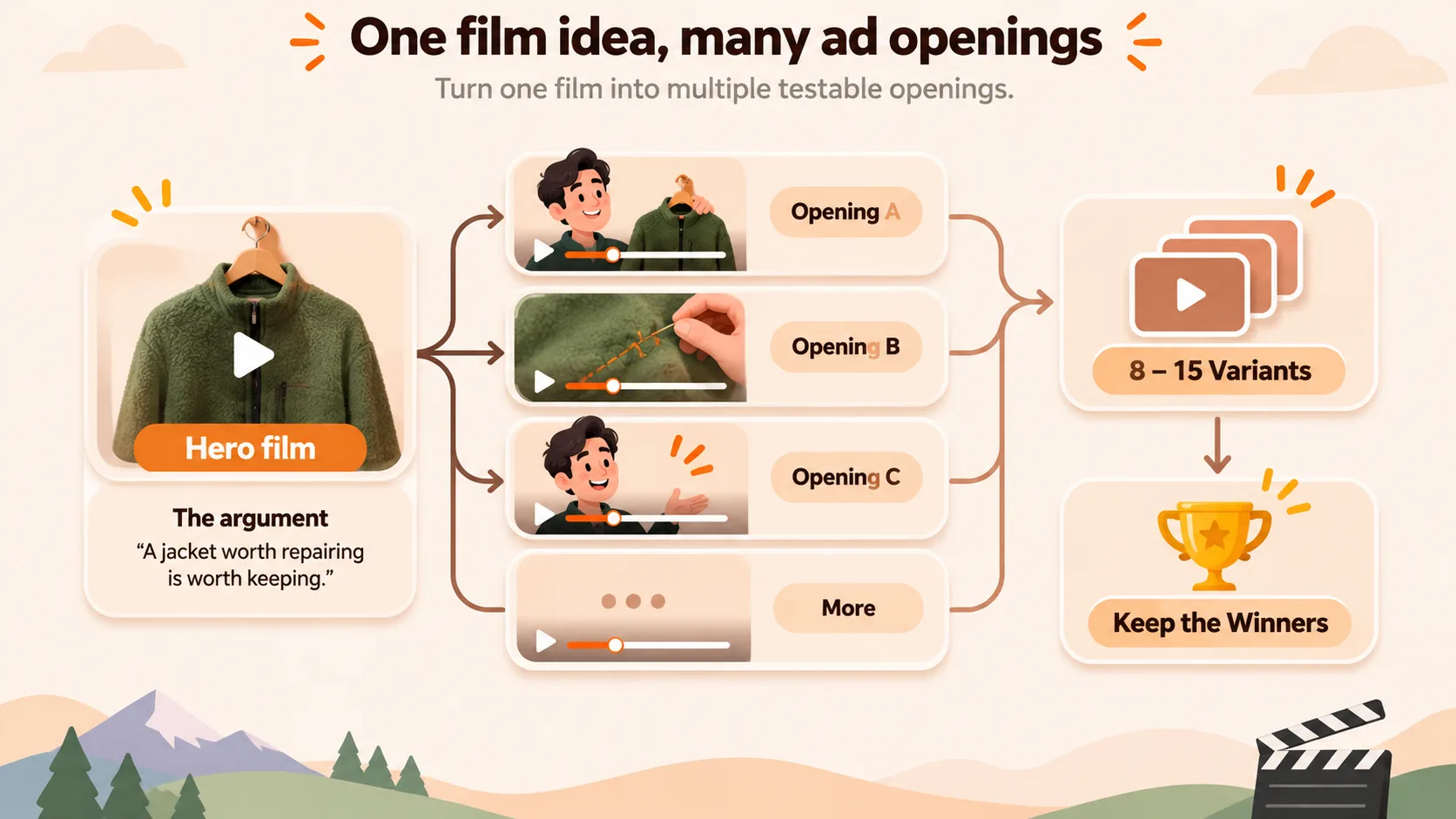
One brand film becomes a batch of ads when you cut six to twelve different openings from the same footage and test them against each other. Four terms make that process clear. A hero film is the main long film. A cutdown is a shorter edit made from it. B-roll is the supporting footage that did not make the main cut. A variant is a version of the same concept with one element changed, usually the opening.
Ad platforms decide what to show through an auction, so they reward volume. In our ad work, the opening is the variable that matters most, because everything after the third second is a much smaller lever.
Here is the method applied to a repair-and-reuse film in the spirit of Worn Wear. Treat it as an illustration of the method, because it does not describe how Patagonia ran its campaign.
Write your film's argument as one sentence. For example, "A jacket worth repairing is worth keeping."
Go through your interviews and b-roll for moments that deliver that sentence in under three seconds each, which matches TikTok's three-second window for introducing the proposition.
Write six to twelve openings for the same concept, changing one thing at a time. One might open on a customer holding a 20-year-old fleece. Another might open on a line of on-screen text about how many times a jacket has been repaired. A third might open on the repairer's first sentence. We build hook batteries of six to twelve openers per concept. Sketch each opening on a storyboard template before anyone films it.
Cut each one vertically with burned-in captions, using the export dimensions each platform expects. TikTok's guidance recommends featuring creators, employees or customers in a style that is not overly polished, which is why customer interviews cut well here.
Run the variants live. We plan on eight to fifteen live variants per concept, and TikTok suggests three to five creatives per ad group and three to five ad groups per campaign.
Keep the openings that win, drop the rest and feed what you learned into your next batch.
Our Nomi project ran this rhythm at scale, with forty-two ad variants in a quarter and four that worked.
AI-generated creator video tests openings at volume well and carries a product story worse than a real creator, so AI video versus a studio is a decision to make per job. We label synthetic footage wherever we use it.
What to Include in a Brand Video Production Brief
Every decision in the checklist below costs more to change once your crew is booked. That is why we write a treatment first, a written document covering the idea, the look and the structure. It costs about a week and spares you the discovery in the edit that your film has no argument. The treatment is one stage in a six-stage process where every stage ends in written approval, so nothing moves forward on an unsettled decision.
Expect our brief call to cover three questions. What is your video competing against for attention, who has to approve it, and what happens if it works? If a video is the wrong fix for you, we say so on that call.
Plan your shoot for more than one asset. A brand shoot is the most expensive day in a content calendar, so your shot list, grouped by location, should yield the hero film, social cutdowns and stills. Founders and customers need interview direction so their answers are usable in the edit. If you want the cutdowns planned alongside the shoot, we can do that from the first day.
A brand film typically takes 5 to 9 weeks even though the shoot itself is often short, because the time goes to the treatment, crew booking and finishing and to extra reviewers. If you have not yet decided what your company believes, start with the argument, because a film built on an unsettled position will not hold. If you need to learn which message sells this quarter, start with an ad batch.
Before your first call, check that you have:
One sentence stating your claim, and the person or act that will prove it.
A decision on the opening, even if it is a draft.
The format and the type from the table above.
The metric and the person who will judge it.
One approver who can sign off without a committee.
A draft script with its runtime checked, since delivery pace and silence change the length as much as word count.
A list of every placement and aspect ratio you will need at delivery.
If you want a second opinion before you commit, send us the brief and we will tell you whether a film is the right fix.
Conclusion
Production is getting cheaper to draft and no cheaper to decide. We use generative tools every day for first-pass scripts, storyboard frames, rough assembly, clean-up and translation, and they are faster at all of it. They remain weak at knowing what a film should argue and at directing a performance, so we expect a specific argument to become the scarce part of the work.
Build a habit that keeps you ahead of that. Whenever a brand video stops you, log it in one line against the hook, format and purpose lens, and sort the log by purpose after a quarter. The gaps show which jobs your competitors leave unclaimed, and the repeats show which openings your category has worn out. Re-read platform guidance before each campaign, because the TikTok page cited here carries its own last-updated date, and let your own tested openings overrule any benchmark, including ours.
Written by the AllCapStudio team. We publish what we would tell you on a call, which occasionally costs us the project.
Read next
All articles- JournalBest Motion Graphics Software for Product Videos and Brand Animation (2026)Revisions, repeat versions and tight deadlines are the hardest part of creating motion graphics for product videos and brand…
- JournalUGC Video Examples: 5 Formats and How Brands Use ThemUGC video examples sorted into 5 types by hook, build and purpose, with real brand cases and a way to test them before you scale.
- Journal10 Best Remotion Alternatives for Non-Developers (2026)Compare 10 Remotion alternatives for non-developers, from free open-source tools to AI agent studios and template APIs, with…