Journal21 min read
Short-Form Video Marketing: How to Turn One Shoot Into a Content Series
Short-form video production stacks scripting, casting, a shoot day, the edit, captions, exports in 9:16 and 4:5, and every round of notes onto one deadline.…
- Published
- Updated
- Written by
- AllCapStudio

Short-form video production stacks scripting, casting, a shoot day, the edit, captions, exports in 9:16 and 4:5, and every round of notes onto one deadline. Then the approved file goes live and the harder job starts.
Getting that video in front of the right people is short-form video marketing, and it rewards volume. 83% of marketers say expectations for their content output have increased since AI became widely available, yet one shoot day usually yields one video. Cut it into near-identical clips and the feed repeats itself while your media buyer has nothing new to test. Nomi, one of our clients, had a version of this problem, with static creative that had fatigued for two quarters and only two polished films a quarter to replace it.
A content series starts with a plan, and the sections below show how to start one and how to turn a single shoot into many clips. You will set one job for the series, plan separate ideas and openings before filming, follow a production schedule, and measure what reaches your audience, so the shoot you already pay for gives you better results.
Why short-form video marketing works better as a series
Short-form video marketing works better as a series because several distinct ideas show you which ones land and give you winners to extend, while a single video leaves you nothing to fall back on if it misses. The research points the same way.
Start with adoption. In HubSpot's 2026 research, 60% of marketers use short-form video, and 49% name it as their highest-ROI content format. The same report draws on a survey of more than 1,500 marketers.
Length matters too. Wyzowl's 2026 report found that 71% of video marketers say videos between 30 seconds and two minutes work best. The survey reached 266 respondents in late 2025, split between marketers and consumers, so read it as a directional signal and not a benchmark.
You do not need heavy polish to compete. HubSpot reports that 76% of marketers say authentic content outperforms highly produced content. Each of your cuts can be plain, as long as the full set covers several distinct ideas.
Your shoot day is the cheapest moment to collect those ideas, because the people, the product and the location are already in place. Shoot days can be short, too. The Field & Form founder film was shot across two counties in a day and a half.
Before planning anything, agree with your team on what "series" means.
What a short-form video series is, and how it relates to repurposing video content
A short-form video series is a set of clips with a shared job, a recurring structure and one idea per clip, all planned around a single shoot. A pile of clips, by contrast, shares only its source footage. You can see the difference in a feed, because a viewer who meets five clips making the same point has little reason to watch a sixth.
What is short form video content? It means vertical clips that typically run from a few seconds up to about three minutes, the longest YouTube Shorts allow. Short-form video marketing is the work of getting those clips in front of an audience and measuring what they do.
Repurposing, batch filming and content batching
A series from one shoot needs both batch filming and repurposing. Batch filming sets the plan, and repurposing produces the cutdowns.
Repurposing video content: reformatting footage that already exists, such as cutting an interview into clips.
Batch filming: also called content batching, this means planning and recording several videos in one session.
If you are asking how to repurpose video content you already have, steps two onward below still apply to you. The limit is coverage. You cannot add a second angle or a new opening to footage that was never recorded. If all you have is existing footage, an AI marketing agent can draft, clip and schedule content from it, with a person approving everything before it publishes.
Plain-English glossary
The table below defines every term this guide uses, so you can read straight through.
Term | What it means |
|---|---|
Job | The one outcome a series exists to produce, such as getting a viewer to open a product page |
Idea | The single point one clip makes, which should make sense without the other clips |
Hook | The opening seconds of a clip, built to stop a viewer from scrolling past |
Hook battery | Several different openings filmed for the same clip body, so they can be tested against each other |
Cut and cutdown | A cut is one finished edit. A cutdown is a shorter or reformatted version of a longer cut |
9:16 | The shape of a full-screen phone video, nine units wide for every sixteen tall, also called vertical |
Safe zone | The part of the frame that app buttons and captions do not cover |
Burned-in captions | Captions built into the picture, so they show when a viewer watches without sound |
UGC | User-generated content, meaning video in the style of an ordinary customer or creator filming on a phone |
Brief | The written plan for a shoot, covering the job, ideas, formats and deadlines |
Creative | The advertising word for an ad's video or image |
CAC | Customer acquisition cost, the spend needed to win one customer |
With the terms fixed, you can start planning.
How to plan a short-form video marketing series before the shoot
Seven steps take you from a single job to a shoot-ready plan. Work through them in order, because each one builds on the output of the one before.
To keep the arithmetic concrete, imagine you run marketing for a kitchen appliance brand. You have a half day with your founder, the product and one kitchen. The numbers below are planning figures for this example and are not results.
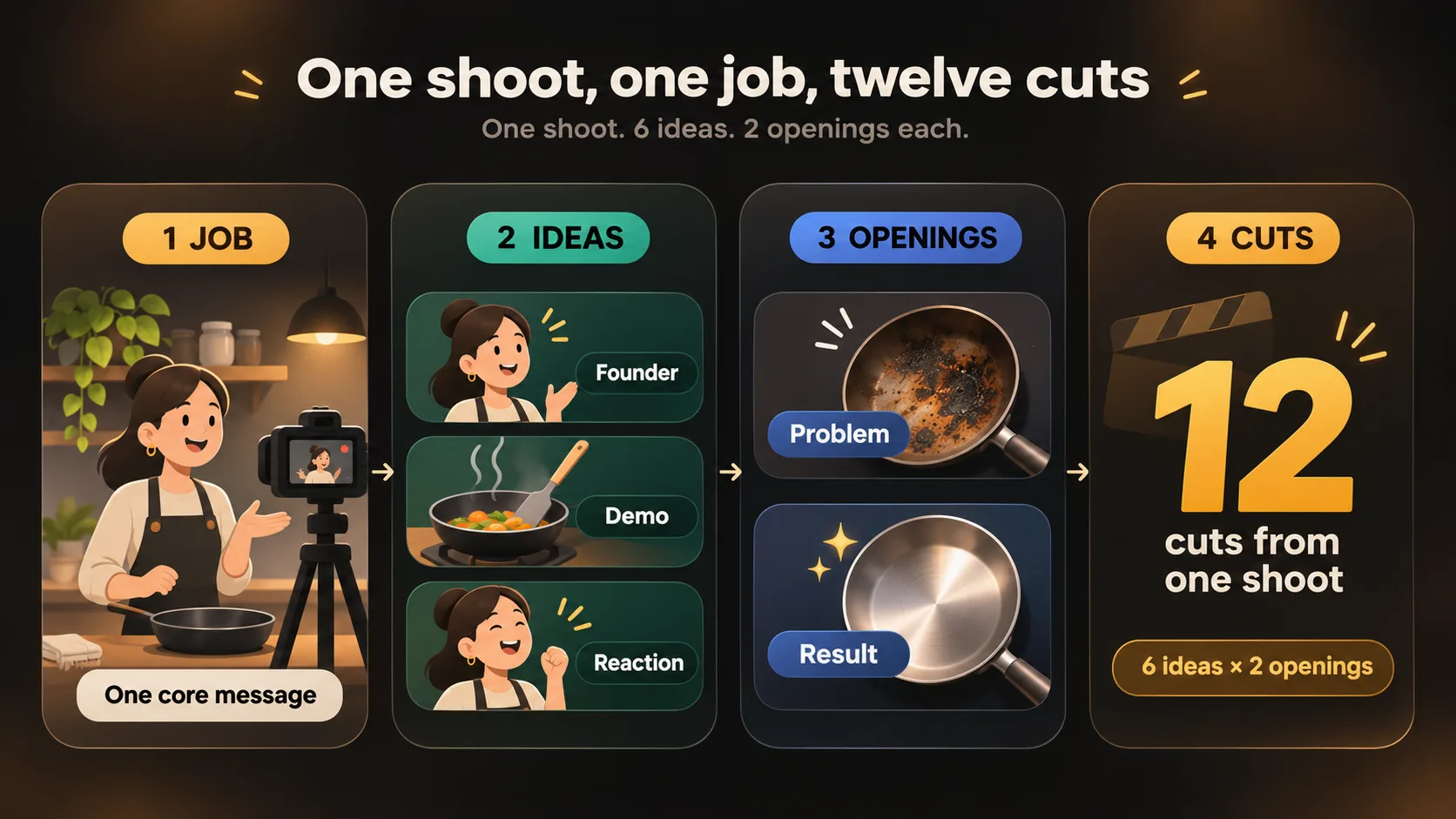
1. Give the series one job
A job names a viewer and an action, and it should match where that viewer is. Awareness means people who have never heard of you. Consideration means people comparing options. Conversion means people close to buying or signing up. Each calls for a different clip, and every later decision depends on the one you pick.
Awareness: introduce the brand to people who have never seen it, measured in views and completed watches.
Consideration: answer the questions people ask while comparing, measured in clicks to the product page.
Conversion: give people close to buying a reason to act, measured in purchases or cost per customer.
Your kitchen brand picks consideration. Its job reads "get first-time paid-social viewers to open the product page." A line like "post more video" names an activity and leaves your clips with nothing to aim at.
The job also decides what every clip must show early. TikTok's creative guidance for performance ads, last updated in June 2025, says to introduce your content proposition in the first 3 seconds. Your proposition is the reason to keep watching, and it comes straight from the job.
Once the job is written down, decide what your clips will say.
2. Break the shoot into single-idea segments
Find your ideas where viewers already show you what confuses them. Support tickets, sales calls and customer questions all work. Quarry Labs, covered below, started from its support queue. We write scripts against recorded sales calls for the same reason.
Then test each idea twice. Can you state its point in one sentence? Does the clip make sense if it is the only one a viewer ever sees? An idea that fails either test needs splitting or cutting.
For the kitchen brand, that gives six ideas across three concepts.
Founder to camera: covers the problem the product solves and the time it saves.
Hands-only demo: covers the cleaning step and a side-by-side with the old method.
Creator-style reaction: covers first use and a comment a week later.
Once you know what each clip says, you can work on how each one begins.
3. Film several openings per idea
Give the opening the most attention. TikTok's guidance recommends prioritizing the hook in the first six seconds by creating suspense, surprise or another emotion. It also describes a structure to follow, with a hook, then your selling points, then a clear call to action.
Because your selling points stay the same, you can film the opening separately from the body and swap openings in the edit.
Our hook batteries run six to twelve openings per concept, and for paid social we plan on eight to fifteen live ad variants per concept to get a usable read within a normal budget cycle. The example plan uses two openings per idea to keep the day manageable.
For the kitchen brand's cleaning idea, the two openings could be:
A problem opening: the founder holds a scorched pan and says how long it used to take to clean.
A result opening: it starts on the clean pan and cuts back to how it got there.
Treat both lines as illustrations with no performance claim. Film your openings back to back so lighting and wardrobe match the body of the clip.
Ideas and openings are decided, so the next job is making sure the camera records what vertical needs.
4. Frame for vertical and record at higher resolution
Shoot in 9:16 from the start. TikTok's guidance asks for vertical orientation at 9:16 and at least 720p, with content kept inside the safe zone.
Cropping a landscape master later costs you most of the picture. Filling a 9:16 frame from a 1920 by 1080 shot keeps about 32% of the width. A 3840 by 2160 frame holds a vertical window of 1215 by 2160 pixels, which scales down to 1080 by 1920 with no enlargement. A 1920 by 1080 frame holds only a 607 by 1080 window, which would need enlarging by about 78%.
So you have two choices. Frame vertical on the day, or record in 4K so a vertical crop still has enough pixels. If a screen recording or a wide shot is part of your plan, recompose it for vertical and do not crop it. When you convert between ratios, an aspect ratio calculator gives you the matching dimensions.
Leave room for the safe zone as well. Meta's Reels ad specs ask advertisers to keep roughly 14% at the top, 35% at the bottom and 6% on each side free of text and logos. We found no published figures for organic Reels, so treat those margins as a minimum and keep faces and captions inside them.
Framing settled, you now need to write all of it down so the crew and every editor work from the same plan.
5. Name platforms, ratios and lengths in the brief
List every destination in the brief before the shoot, with its ratio, planned length and cut type. A format missing from the brief becomes a second round of production on delivery day. The finished format list for the example appears in the production plan below.
Check the limits when you write the brief, because they change. YouTube's help page says Shorts can run up to three minutes if the video is square or vertical. Platform limits differ, so confirm each one on its own help page.
The brief says what you need. The shot list says how to capture it in the time you have.
6. Build the shot list and shoot in blocks
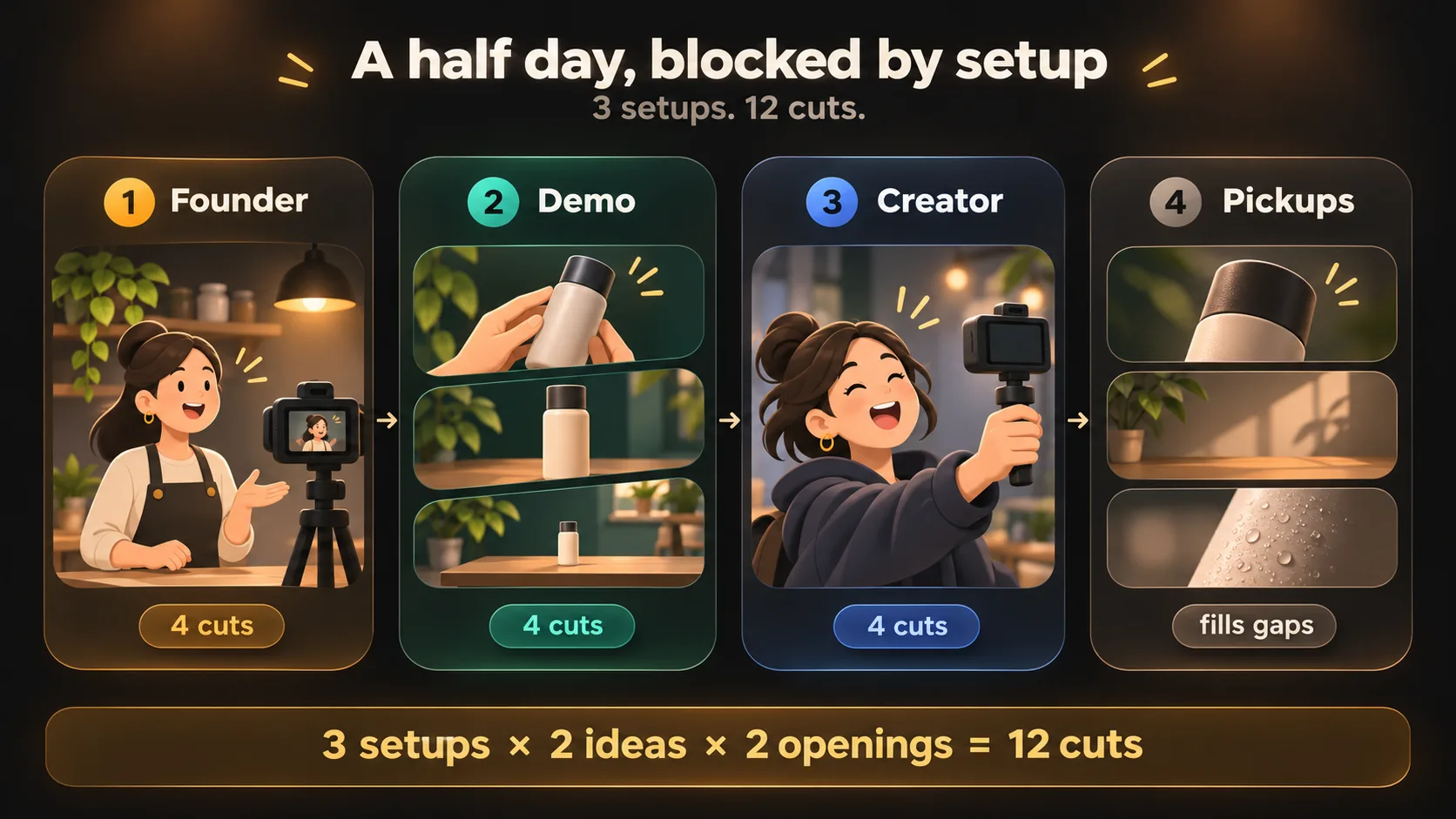
A shot list is the ordered list of everything your crew must record. Block the day by setup so lighting and positions change as rarely as possible. Build the list in a shot list builder that groups shots by location and exports it for your crew. The illustrative half day looks like this.
Block | What gets filmed | Why in this order |
|---|---|---|
Founder setup | All openings first, then the body of each idea | Same wardrobe and light across every opening |
Demo setup | Each task at wide, medium and close distance | Gives the edit different angles for each cut |
Creator setup | First-use and week-later reactions, handheld | Different look from the other two setups |
Pickups | Product inserts and empty frames with space for captions | Fills gaps the edit would otherwise have |
When the footage is in, the last planning decision is how you will cut it.
7. Cut for different jobs as well as different crops
Assign each cut a purpose before you open the edit. A 15-second teaser, a 30 to 60 second proof cut that shows the product doing the work, and a longer explanation each do different jobs.
Variety also matters for testing. TikTok's guidance suggests 3 to 5 creatives per ad group and says it is better to use creatives with big differences, especially when testing. Twelve openings on one shot give you one idea in twelve versions. Plan at least three concepts that differ in speaker, setting or angle, then add openings within each.
Originality rules will not get in your way. Instagram's guidelines list photos and videos you took yourself as original content, so cutdowns of your own footage qualify.
The plan now holds one job, six ideas, three concepts and twelve cuts from a single half day. The next step is turning it into a production schedule.
A practical production plan for creating multiple assets from one shoot
The seven steps decide what you film. A production plan decides who approves what and when, so the shoot reliably produces every asset you named in the brief. At AllCapStudio we run every project through a six-stage production process, each stage ending in a written approval, and a series fits that structure.
The six stages applied to a series
A series moves through six stages, from Brief to Deliver, and each one ends in a written approval. The timings below come from our published process for a standard project. The series details belong to the illustrative kitchen-brand example. Video ads and UGC run on a shorter cycle of two-week batches.
Stage | Typical timing | What happens for the series | What you approve |
|---|---|---|---|
Brief | Day 1 | Name the job, the ideas and every format | The written brief, including the format list |
Cast | Days 2 to 4 | Match a director and editor to the brief and shortlist creators for the reaction concept | The team and the creator shortlist |
Script | Weeks 1 to 2 | Write the body of each idea and draft the openings against your sales calls | The scripts and the opening lines |
Board | Weeks 2 to 3 | Draw each concept's frames and mark the caption space | The look and the beat structure |
Build | Weeks 3 to 5 | Shoot in blocks, deliver a rough cut at the halfway mark, then finish the cuts | The rough cut, then the final cuts |
Deliver | Week 5 | Export every cut in every named ratio, with captions and source files | The file list against the brief |
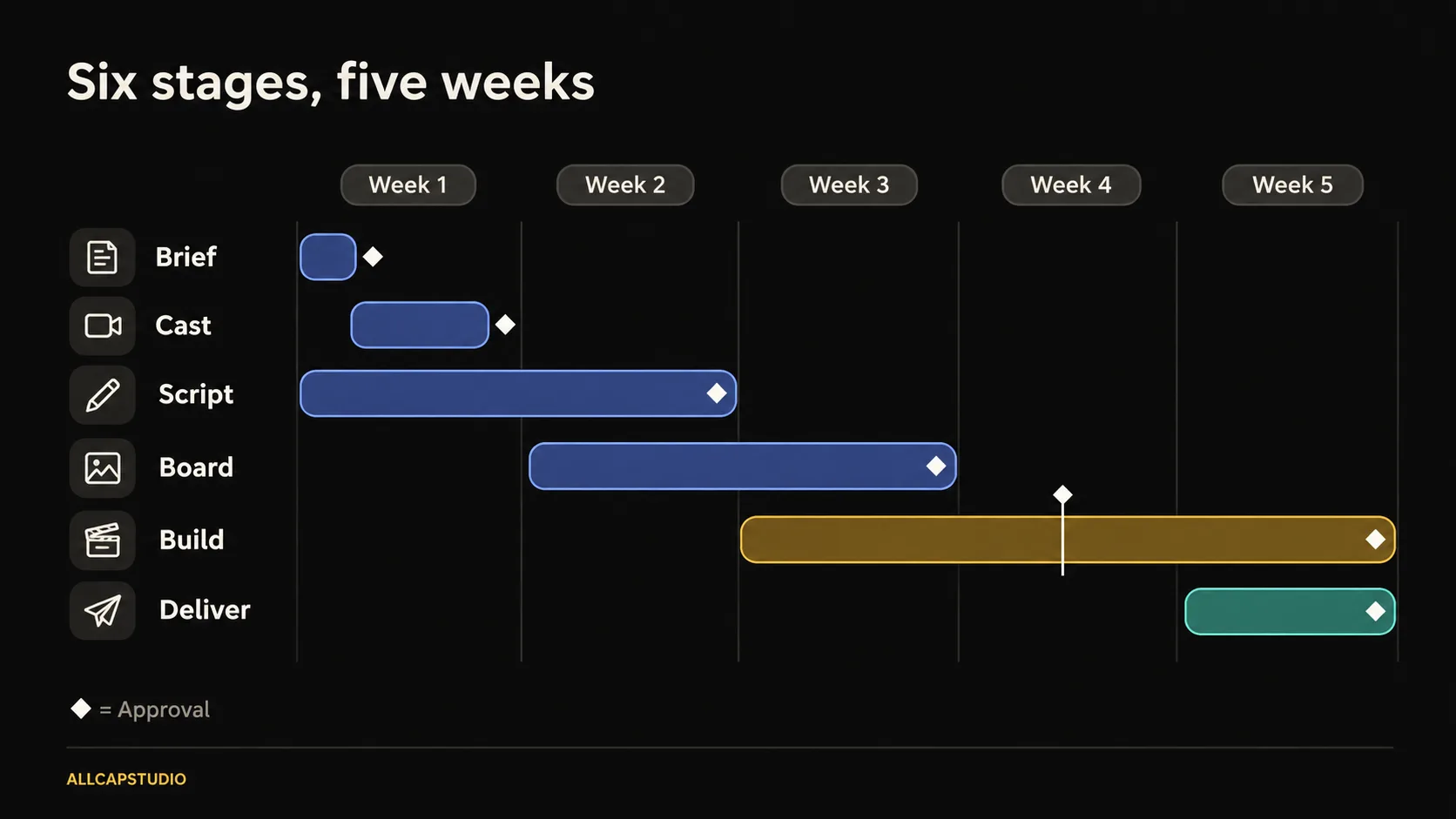
Script and storyboard sign-off are the points where schedules slip most often, so approval speed matters more than anything that happens on set.
The assets one shoot can produce
List the assets before you shoot so the footage and the file list match. For the example series, the half day yields the files below.
Asset | Ratio | Length | Built from | Job |
|---|---|---|---|---|
Core cuts | 9:16 | 15 to 60 seconds | Six ideas with two openings each, 12 in total | Reels, TikTok and Shorts placements |
Feed versions | 4:5 | 15 seconds | The teaser cuts, reframed so faces and captions stay inside the crop | Instagram feed placement |
Cutdowns | 9:16 | 15 seconds | Any proof cut that runs long | Quick tests of the strongest idea |
Burned-in captions | Built into every cut | Same as the cut | The scripts | Silent playback |
Source project files | Not applicable | Not applicable | The edit | Later re-cuts and refreshes |
Ownership of these files transfers to you on delivery, so check the list against your brief that day.
Shoot-day documents
Two documents keep a multi-concept day on schedule. Storyboard templates let you draft each concept's beats before the first call, and a call sheet generator staggers call times and keeps a running schedule for shoot day.
A checklist before you book the shoot
Settle these three points first. Each one removes a common cause of delay.
One approver and one note-taker: name the person who can approve a script without a committee, and a single person who gathers everyone's feedback and returns one set.
A real ship date: the date the series must be live, with no padding.
Existing material: sales calls, product access and brand assets, shared in week one.
With the plan and the asset list settled, a half day of footage turns into a file list you already know. Two projects we ran on the same logic show the result.
Short-form video series examples broken down by hook, format and purpose
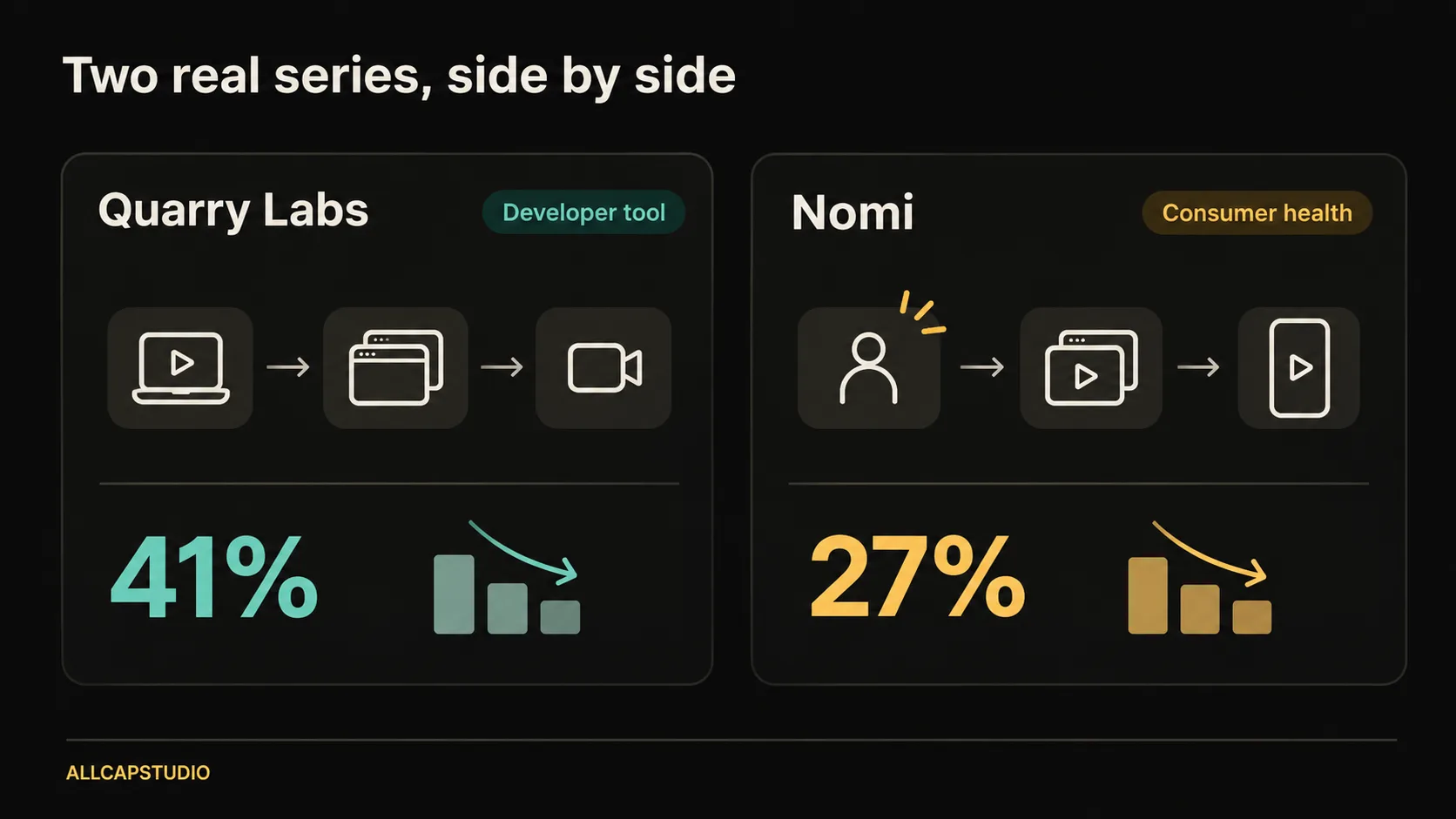
Both series below show the plan working. Quarry Labs turned one recording session into six single-task films, and Nomi turned monthly batches into 42 ad variants. One caution applies. The outcomes are reported by us and our clients on our case pages, and they were not audited by a third party. Finished films are shared on request, and each note says where the example differs from a single-shoot vertical series.
Six single-task walkthroughs from one recording session
The problem: Quarry Labs, a developer tool, had thorough documentation and a support queue full of questions the documentation already answered. The team had been quoted for one polished overview film.
The decision: We argued for six short films with one task each, placed in the product where that task happens. We built a seeded workspace, meaning a demo account filled with plausible sample data, so the terminal output looked like real work. Walkthroughs like these fall under product demo videos, where a demo follows one person completing one task with a visible outcome.
The result: Onboarding-tagged support tickets fell 41% over the following quarter, according to the case page.
What transfers: The series is 16:9 and sits inside a product, so it is not a vertical feed series. The structure carries over, with one task per film and one session to record all of them.
Forty-two UGC variants in a quarter
The problem: Nomi's paid social ran on static creative that had fatigued for two quarters. The previous arrangement delivered two polished films a quarter, which gave the media buyer little to test.
The decision: We moved the account to monthly batches. Each batch started from the previous month's data on which mechanism won and which hook died. Creators were cast per batch to keep the faces fresh. Every concept shipped as a hook battery with the body held constant, so any change in results could be traced to the opening.
The result: Blended CAC fell 27% against the previous quarter's static creative, as reported on the case page. Blended means the account-wide average cost of winning a customer.
What transfers: Nomi's series came out of monthly batches and not one shoot day. The logic still applies to you. Hold the body steady, vary the opening, and read the results before the next batch.
Example | Hook approach | Format | Purpose |
|---|---|---|---|
Quarry Labs | Embedded in the product at the point of the task | 16:9 screen demo, six films of about 50 seconds, burned-in captions | Cut onboarding support tickets |
Nomi | Hook batteries with the body held constant | 9:16 creator-led UGC, 42 films of 15 seconds, winners also delivered in 4:5 and 1:1 | Test paid social creative |
Your job may differ from these two, so the next section helps you choose a style that fits it.
A hook, format and purpose matrix you can reuse
Pick the purpose first, then the format, then the hook, and use this matrix to make that choice on purpose for your short-form video marketing.
Our video ads and UGC service describes four ways to build a series. The matrix pairs each with a purpose, a hook to try and a watch-out. The hook suggestions are planning ideas for you to test and carry no performance claims.
Style | What it is | Best purpose | Hook to try | Watch for |
|---|---|---|---|---|
Creator UGC | Real creators, filmed on a phone | Paid social conversion | A problem named to camera in the creator's own words | Casting and usage rights |
Founder-led | Direct to camera, high trust, low production cost | Consideration and trust | A claim only the founder can make | Clips that start to sound alike |
Motion ads | Animated, for products with nothing physical to hold up | Awareness and explanation | The result on screen before any words | Longer build time per clip |
AI-assisted UGC | Synthetic reads for volume testing, labelled as such | Testing many openings quickly | The same proposition in several phrasings | Trust cost with viewers |
Match the format to where the viewer stands. People who do not yet know they have the problem need an explainer video, and people comparing options need to watch a demo follow one task from start to finish.
Motion ads follow the same planning steps, with one change. On animation projects the storyboard is approved before anything is animated, because a design change after animation starts means a rebuild. AI-assisted reads suit volume testing of openings. A real creator carries a product story better, so the split between AI video and studio production depends on what the clip must prove.
With your style and hooks chosen, you can turn to the question of when to publish and in what order.
How to release your short form video content strategy from one shoot
Release your strongest idea first and let the data decide which clips to extend. The order you publish in decides what your short-form video marketing teaches you.
Publish your strongest idea first, with two different openings.
Read the results after enough time has passed for the platform to show them.
Publish the remaining ideas, and re-cut the winner with new openings.
Start the next batch from what the data showed, as Nomi's monthly batches did.
How long should short form video content be? Length follows the job, so set it from the cut type in your brief. The Nomi films ran 15 seconds and the Quarry Labs films ran about 50.
Write your captions and on-screen text for the questions viewers search for inside each platform. HubSpot's trends research advises treating social as a search channel, because captions, on-screen text and spoken words are all indexable.
Once your clips are live, you will be collecting numbers. The next section tells you which ones to trust.
How to tell whether the series worked
Judge your short form video content marketing by the one measure that matches the job, and choose it before you publish. The wrong measure can make a good series look weak.
Wyzowl's survey shows how varied the habits are. 67% of video marketers measure ROI through views, 52% through leads or clicks and 32% through bottom-line sales. If your series is built for consideration, judge it on clicks to the product page, because views alone would hide whether it did its job.
Measurement is a common weak spot. HubSpot's 2026 report names ROI measurement as the top marketing challenge. Quarry Labs tracked support tickets and Nomi tracked cost per customer, and each number maps straight to the job its series was built for. Do the same with yours.
Plan for wear as well. TikTok's guidance says to refresh creatives when delivery shows a consistently declining trend, and to add new creatives to the existing ad group so it keeps running. Your shoot gives you the material to do that without a second shoot, provided you held some cuts back.
Measuring tells you what is working. The last decision is who does the work.
In-house or studio for a short-form video series
Run the series in-house when each clip is cheap and speed matters, and bring in a studio when the series feeds paid testing.
Most teams already do this themselves. Wyzowl found that 59% of video marketers create video in-house, 10% use external vendors exclusively and 32% use a mix.
In-house suits a weekly tip series or a founder talking to a phone. A studio suits paid testing, which needs creator casting and briefing, usage rights, hook batteries, and delivery in 9:16, 4:5 and 1:1 with spec checks. In-house teams, freelancers and studios differ on cost, speed and where each tends to fail.
Ask yourself three questions before deciding.
Do you need more than three visibly different concepts?
Will the clips run as paid ads?
Will anyone on your team have time to brief creators, clear usage rights and cut every format?
Yes to the first two and no to the third points to a studio. A studio will not fix a series with no job, and on a first call we ask what the video competes against for attention. If video is the wrong fix, we say so.
Whoever does the work, the plan stays the same.
Conclusion
Editing tools will keep getting faster, so every team will be able to publish more clips. In short-form video marketing, a feed full of clips rewards the ones that say something different, which puts the advantage on planning. Tools can cut and caption in minutes, but they cannot choose your job, pick your ideas or film the second angle you forgot to record.
Before your next shoot, write four lines. State the job, list one idea per clip, note the openings for each idea, and name every format you need. If the clips would read as three different concepts in a feed, you have a series. If any line is empty, the shoot is not ready.
Written by the AllCapStudio team. We publish what we would tell you on a call, which occasionally costs us the project.
Read next
All articles- Journal8 Best Free AI Video Generator in 2026Find the best free AI video generator in 2026. We compare 8 free plans on credits, watermarks, resolution and commercial use, with…
- Journal6 Best HeyGen Alternatives in 2026, Compared by Price, Limits and FitCompare 6 HeyGen alternatives for 2026 by price, free plans, limits and fit, including Synthesia, CoAnimator, Colossyan, D-ID…
- JournalHow to Choose a Product Video Production Agency for Your Product TeamShortlist a product video production agency with five checks, real price ranges and a 100-point scoring sheet built for SaaS…